Saturday, February 6, 2010

My Imaginary Friend

The view that you can’t be moral without God is one of the most widely held among believers.  The claim is muddled by ambiguities, however.  Does it mean that people won’t behave morally unless they believe God exists?  Billions of non-believers on the planet who are perfectly decent people prove that wrong.  Does it mean that people wouldn’t have a moral conscience if it weren’t for God?  Animal research that has discovered remarkable proto-moral behavior in animals from rats to monkeys shows that that’s mistaken too, although I expect that once this research becomes too widely known to reject or ignore, believers will start claiming that the animals got their morals from God too.  Does it mean that unless a person believes, they won’t have the right motive for doing the right thing?  No, doing the right thing because you think you’re being watched or threatened with punishment isn’t being moral; that’s utterly selfish.   

Any way you parse the claim, it comes out absurd.  But what’s even more difficult to sift from the believer’s confused assertions is any clear account of what God wants us to do.  Even a casual read of the Bible or other religious doctrine makes it immediately clear that what believers typically do is emphasize the passages that suit them and ignore the ones that don’t.  They’re all sure that we have to consult God to find out what’s right and wrong, but thousands of years of bickering makes it quite clear that there’s no agreement about exactly what those rights and wrongs are.  If their example is any indicator, God wanted us all to cherry pick the rules that we agree with and then find ways to explain away the ones that we don’t. 

For some firsthand evidence that you don’t think, reason, or consult the Bible to get your moral values, go to http://yourmorals.org/, create an account, and take the Moral Foundations Questionnaire, the Sacredness Survey, and the Disgust Scale survey.   The results will be quite revealing, and it shouldn’t be hard at all to imagine that your moral reactions to challenging situations is the product of evolutionary forces. 

These may sound like snarky over-generalizations, but new empirical research shows that people are more prone to project their own ethical judgments onto God and attribute them to him than any other agents.  That is, when people are asked to make estimations of the ethical views of other humans and of God, they are most egocentric about God—whatever they think is wrong, it just so happens that God does too.  And whatever they think is morally right, it just so happens that God endorses that too, even when their own views about what is right or wrong change.  Claiming that your moral judgments have a divine foundation amounts to little more than dressing up one’s instinctual or visceral reactions and giving them a supernatural stamp of approval.    

Epley, Converse, Delbosc, Monteleone, and Cacioppo  conducted a series of surveys and studies to get people to give estimations of the moral judgments of others.  In one case, people were asked to predict the views of people whose moral beliefs are well known, like George Bush’s, and people whose views are not well-known like Barry Bonds.  They were also asked to speculate about God’s views.  Other studies they conducted found ways to bring out the subjects’ moral views and then test the subject’s estimations of God’s beliefs.  The researchers even devised a way to map the regions of the brain that were most active during thinking about other people, self, and God. 

What they found was incredibly revealing.  It turns out that it you’re a liberal, then God is too.  If you’re a Republican, then so is God.  If you are opposed to abortion, or same-sex marriage, so is God.  Subjects consistently made the most egocentric attributions to God.  No matter what their views were, God shared them across the board.  But these same subjects would not do that when making estimations of the moral views of other humans.  Even fMRI scans showed that when people were thinking about God’s beliefs the brain activity was most similar to that when they were reflecting on their own views, in contrast to areas of the brain that were active when subjects thought about other humans’ beliefs.  Who would have thought that God is just like me, no matter who I am or what I believe?  How could that be?  Maybe it’s because God is imaginary?    

The authors say,  

In both nationally representative and more local samples, people's own beliefs on important social and ethical issues were consistently correlated more strongly with estimates of God's beliefs than with estimates of other people's beliefs (Studies 1–4). Manipulating people's beliefs similarly influenced estimates of God's beliefs but did not as consistently influence estimates of other people's beliefs (Studies 5 and 6). A final neuroimaging study demonstrated a clear convergence in neural activity when reasoning about one's own beliefs and God's beliefs, but clear divergences when reasoning about another person's beliefs (Study 7). In particular, reasoning about God's beliefs activated areas associated with self-referential thinking more so than did reasoning about another person's beliefs. Believers commonly use inferences about God's beliefs as a moral compass, but that compass appears especially dependent on one's own existing beliefs.

What this suggests, of course, is that people don’t really get their moral judgments from God at all, despite their insistence that all morality comes from God.  There’s too much variation in what different people think they are getting from God.  The arrow is really going the other way—God (the imaginary being) gets all of his views from people.  And one of the reasons that it’s so easy to attribute so many conflicting ethical judgments to God is that the sources of information about God’s views like the Bible are so hopelessly vague, scattered, and contradictory.  People were much less likely to attribute their own views to people like Bush or Obama because we actually know what they think about the issues.  But the vagaries of religious doctrines surrounding God make him a more or less blank slate for people to write themselves upon. 


In one of the most revealing studies, the researchers manipulated the subject’s moral views about some topic by having them write and deliver speeches for or against some position.  The subjects’ attitudes about the position varied in parallel with the position they were assigned to defend not suprisingly.  When you have to actually think hard about the other side, you tend to soften your stance or change your mind.  Have them deliver a speech in favor of the death penalty and their views shifted in favor of it, and vice versa.  And when they were tested before and after the manipulation, it became clear that their assessment of God’s view of the position shifted too.  According to the subjects, God (and the subject) favored the death penalty more before the subject wrote and delivered a speech opposed to it, and then God’s view of it shifted against it afterwards along with the subject’s. 

It’s very difficult not to be cynical about what this is suggesting.  Apparently when believers make declarations about God’s moral judgments, what that really means is something like, “Whatever I happen to be thinking at the moment about what is right and wrong, well, that’s what God wants.”  Or, “not only do I hold the correct moral views, but mine are endorsed by the creator of the universe himself.”  And sometimes even, “If you disagree with me, then that means you’ll be punished for eternity in hell.”   Furthermore, it pretty clear that if someone thinks that they’ve got divine sanction for their peculiar list of moral rights and wrongs, they are not going to be receptive to the suggestion that they could be wrong, or that there could be subtleties in the issue that they are missing, or that they might come to have a more sophisticated and intelligent view if they reflected on the topic with an open mind.  But there’s no need for an open mind or any constructive reflection on your views when you’ve got God on your side and he’s already settled the issue once and for all. 


There’s a form of moral narcissism going on when believers righteously proclaim God’s will.  They aren’t offering a moral opinion with some reasons to support them—they are issuing God’s own commandments.  Their views are views of the almighty creator of the universe.  Take heed or burn for eternity.  But we must listen closely because my/God’s views are subject to change at any time. 

The view that morality comes from God suggests that there is a single source of infallible moral guidance, and that ultimately the responsibility for figuring out what is right and wrong is not on our shoulders.  Our position is merely to be obedient to God’s higher authority.  So the appeal to God’s authority to settle moral questions effectively cuts off any real and careful analysis of the vital details.  Our job isn’t to figure out what is right and wrong, after all, it’s just to do what God tells us.  So what’s particularly dangerous here is how a set of unreflective moral intuitions are getting promoted to the status of divine command with the introduction of God into the picture.  If we were realistic and conceived of moral problems as falling squarely on our shoulders to solve with the resources we have, we would give them the sort of in depth consideration they deserve and we’d work harder to figure out what makes some things right and some of wrong. 

Thursday, January 21, 2010

Open the Floodgates


Maybe you thought you’d be able to bridge the great divide between the natural and the supernatural worlds and get to God through faith?  The evidence for God isn’t compelling, and there are lots of things that suggest there isn’t one.  But if you just have faith that he’s there, then you can believe and be confident that he’s real.  Maybe you thought having faith gives you a special kind of knowledge even. 


In their paradigm cases, we use the term faith to describe a case where a person’s epistemic situation doesn’t fully warrant believing on the basis of evidence.  There are some counter indications or some lack of evidence that leave the conclusion unresolved.  When a person’s favorite sports team is down in the last few minutes but has a slim chance to come back, he has faith in them.  A wife has faith in her husband when he’s away on a business trip with an attractive coworker.  Worried family members, in the emergency room waiting room, have faith that their critically ill loved one will make it through the night.  And so on.  We only invoke faith when there are some reasons to doubt or the result we desire seems unlikely.  Where there is evidential justification, there is no room for faith. 

That’s why faith is so frequently the response that believers give when they are pressed hard on the grounds for believing in God. 

But here’s the problem.  Reason is the set of cognitive capacities that make it possible for us to seek out evidence, sift through it, and draw conclusions.  (Evidence here should be broadly understood to include empirical as well as conceptual or a priori considerations.)  Our reasoning capacities are the only tools we have for separating reality from fantasy, fact from fiction, justified belief from nonsense.  Once you abandon it, then you’ve opened the floodgates.  Once we let it go, there are no principled, coherent, or meaningful grounds on which to prefer one God over another.  As long as you were just thinking about the one God that you’re familiar with, the one that everyone around you seems to believe in, then making the leap of faith sans reason, doesn’t seem so problematic. 

But here’s a question:  How many supernatural hypotheses are out there for your consideration?  How many gods are vying for your faith?  Is the only game in town the God that the people in your church have been telling you about?  Obviously not.  There is a very long list of other beings lurking over there, waiting to get in.


Before, when you still had reason at your disposal, at least you had some means of singling the right one out of this mess.  But if we write off the role of reason in making decisions on the basis of evidence, we have a dilemma.  On what basis will you decide to opt for one of these gods and not the others?  Since you’re allowing that it’s ok to abandon reason and just believe what you like without regard for the evidence, then why no Baal, Acchupta, Ryangombe, Pu’gu, Pen Annwen, Orcus, Orunmila, Nintinugga, Ningirama, Montu, Mahamanasika, Kamrusepa, Haumiatiketike, or Hatdastsisi.  Faith in one is just as good as faith in another, right?    


You’ve opened the floodgates to any and all gods, and left yourself without the means to choose or hold any of them back.  Reason and the evidence were the only things you had to hold back countless mistakes. 

That is, there’s not a sufficient case to be made in favor of believing any of one of these and rejecting the others on the basis of evidence, so what’s to keep one of the devout followers of Hatdastsisi from pulling the same move.  “The only way to true belief in Hatdastsisi is through faith,” after all, “and those of you who don’t will suffer with eternal torment.”    

You’ve given up the one  tool you had for making a choice here on the basis of any rational standard.  If the evidence (or lack thereof) doesn’t matter, then all of these supernatural beings are on the same footing.   Notice the irony in someone who is willing to abandon good sense and believe against contrary evidence, but who says about all these other gods: “but those other gods just don’t make sense.”  Since when was making sense the issue for someone who is opting for faith over what makes sense? 

Of course, you’ve got a special place in your heart for the divine being that your parents taught you about, and the one that the other members of your culture or religious sect all believe in.  But those aren’t reasons to think that he really exists.  That you were born into a Christian household and culture is a historical contingency. 

The thing is,  you might not think there’s as much to recommend  Haumiatiketike as there is to recommend Jesus, or whoever your favored magical being is.  But if you try to defend your opting for the same God that you were taught to believe in as a child, and you’re going to play the faith card, then you’ve set yourself up with an irreconcilable problem.

On the one hand, when the evidence and reasoning wouldn’t produce the conclusion that you wanted, you thumbed your nose at them and decided you’d belief what you wanted anyway.  But on the other hand, now you’re trying to argue or reason that there are some grounds for thinking that God is real and the others are not.  You just can’t have it both ways without being flagrantly irrational.  Gerrymandering some defense of believing in your God by faith while rejecting all of the others is a flagrant example of special pleading or the ad hoc fallacy. 

Maybe you think that having faith in Jesus is more fulfilling or somehow more enriching for human life than all of those others.  But notice again that you invoking a reasoned principle that is something like “People should adopt those religious doctrines that are most fulfilling in X, Y, and Z fashion.  Having faith in Jesus is most fulfilling in X, Y, and Z fashion.  Therefore, people should have faith in Jesus.”  There are two things that are seriously messed up here.  First, this believer is making use of some logical inferences only as long as it suits him, but rejecting them when they give him any conclusion that is contrary to the Jesus conclusion he wants.  And second, notice that we’ve left the discussion about truth entirely.  It might be that there are some pragmatic benefits to certain kinds of cognitive practices, but those never entitle a person to claim that some claim is true.  It gives me a thrill to believe that a billion dollars has mistakenly been deposited to my bank account too, but I’m not entitled on the basis of those positive personal feelings to conclude that it is really in there.  Personal fulfillment never gives us epistemic justification. 


What the faith move does, in effect, is throw out the rules.  It shows that you’re just going to believe it regardless of what the real indicators point to.  And by throwing out the rules, you mire yourself in nonsense, and you disqualify yourself from any serious consideration.  You also undermine your own efforts to try to make sense of anyone else’s view.  Suppose the atheist pulls the same move. 


Atheist:  I know that there are no gods whatsoever.


Believer:  But how can you ever know something like that for sure?


Atheist:  I have faith that there are no gods. 


Believer:  That doesn’t make sense.  How can you have faith in something that isn’t real?  You can only have faith that there is a God. 


Atheist:  I don’t have to be concerned with what makes sense—I’m off in faithland now.  And in faithland, reason, evidence, and good sense are disregarded so that I can help myself to any conclusion we want without worries about being coherent or making sense.  Those are petty evidential and rational concerns that are all left behind by faith.  My faith in the vast godlessness of the universe is beyond human comprehension--it transcends our puny understanding.

Actually I find it all surprisingly comforting.  As soon as I let faith into my heart, all my worries and cognitive needs about figuring out the truth and being reasonable dissolved.  Faith brings great peace of mind.  It deadens the acuteness of the persistent need I felt before to gather as much reliable information I could and draw the most reasonable conclusion I could on the basis of it.  Now I don’t have to worry about any of that.  Now I’ve realized that I can just believe anything I like without any responsibility for justifying it.  If I want it, I can just help myself to it.  As long as I'm at it, I'm going to have faith that global warming isn't real, there are no religious conflicts in the middle east, and that there's a million dollars in my bank account.  

Believer:  But that's all insane.  What about your responsibilities as a citizen and a moral agent in a society with the rest of us?  How can you think that the evidence is irrelevant to what you believe, or that you can just dismiss the importance of rationality?  

Atheist:  You know, I don't like your tone.  You’re angry and strident.  You're being intolerant and critical of my faith.  I'm exercising my religious freedom by opting out of being rational, and you have to respect that or you're not respecting my personal religious choices.


Many believers retreat to the “F” word as their last ditch effort to defend believing in God.  Faith has a number of features, but principle among them is that it describes cases where we believe that something is true even though the evidence on the whole does not support it.  If there were sufficient evidence, after all, there would be no need for faith.  Many people also view this sort of fudging as harmless.  But what we have seen is that it creates a crisis.  If the evidence doesn’t matter in our justifications for what we believe, then floodgates are open for any sort of insanity to rush in.  Taking the evidence seriously was the only way we had to sift the claims that are plausible from the ones that are delusional, dangerous, or absurd. 

Tuesday, January 19, 2010

Atheism--Internet Encyclopedia of Philosophy

My article on atheism is now published at the Internet Encyclopedia of Philosophy.  I worked out much of the material here on this blog.  Thanks to all of those who contributed.

Atheism at the Internet Encyclopedia of Philosophy

Friday, January 15, 2010

Are We Proving the Negative Yet?

Let’s consider a line dividing the natural and supernatural worlds. We can leave some of the details of what this line is, exactly, open for now.  The natural world is where we live.  That’s where our brains are, science is here, Lady GaGa, down quarks, and bacteria live here.  And all of our tools for empirically  investigating reality reside here.  Science operates here with particle accelerators, telescopes, biology labs, and so on.  So provisionally the line between worlds is the line between those things that we can investigate with scientific methods—spatial-temporal entities, forces, and phenomena, broadly considered. 


What’s on the other side?  Well, there have been many proposals.  Ghosts, if they were real, would be there.  The souls of dead people who psychics talk to would be there.  Our prayers are alleged to cross the line.  Angels, demons, saints, and all the other things that have been alleged to be real, but not part of the natural world.  And of course, God, by most descriptions, if he was real would be there.


Our challenge, then, is to use the tools we have—our empirical and not so empirical methods—to do our best to figure out what’s real over there.   We know that people have always eagerly proposed many inhabitants for that world.  Over the millennia the number of supernatural hypotheses that have been put forward is staggering.  But lots of them, it turns out, are bogus.  Demons aren’t real.  Ghosts aren’t real.  Paluga, Odin, Oprah’s favorite mystical force The Secret, aren’t real.


Everyone, including enthusiastic supporters of Odin and ghosts, has to acknowledge that there must be some criteria of reasonableness that we can employ to sift the real from the imaginary when we consider various proposals for supernatural beings.  We’ve at least got to try to use the resources at our disposal to figure out which of those we should believe in and which we should be doubtful of.  The alternative would be to simply accept all of them, I suppose.  But no one actually does that, nor do they think that’s reasonable.  And we can’t accept all of them as real because many of them are mutually exclusive:  if the Muslim Allah is real, then the existence of Catholic saints in the afterlife presents a problem; if Paluga created the universe, then a number of other views about the origins of the world must be ruled out. 


So what tools do we have?  We can gather as much empirical information as we can and try to construct the best, most comprehensive, most logically and probabilistically consistent model of reality on the basis of it.  We infer the existence of unobservable (but natural) entities on the basis of observables all the time.  The data from bubble chambers in a particle accelerator are explained by the presence or muons, or a readout on a mass spectrometer leads us to postulate the presence of a chemical compound in a sample.  It may be that the best explanation of some particular set of empirical observations is that there is a supernatural being on the other side—that’s what “irreducible complexity” and intelligent design arguments allege to show.


Alternately, we can employ more conceptual methods.  We can just ask ourselves if the supernatural proposal even makes internal, logical sense.  Are the various claims about this supernatural entity consistent with each other?  If they are not, then at the very least, that should raise a red flag about the plausibility or viability of the proposal.  (I dealt with the possibility of acquiring private knowledge of God through your own thoughts here:  Vetting Supernatural Knowledge Claims)


When we have a proposal for an inhabitant of the supernatural realm, then, first we need to get clear on exactly what sort of thing it is alleged to be and what sorts of properties it has.  Then we need to see, to the best of our abilities, whether what that thing is alleged to be fits with two things.  First, does it fit with  our empirical observations of the world and the scientific model of reality that we have developed to explain them.   If it doesn’t, then either there is something wrong with the model, or there is something wrong with the supernatural hypothesis.  Which one we should prefer in this case will depend on the strength of the evidence we have for the empirical model of the world against the strength of the evidence we have for the supernatural entity  A concrete example:  consider the fundamentalist Christian God who, among other things, is alleged to have created the entire universe, the Earth, and all life in its current state of development in just seven days approximately 6,000-10,000 years ago.  This is a supernatural being that might be real, and whose existence would have some observable implication in the natural world where we live.  So in principle, this is a supernatural being that we can investigate empirically. 


It would be a gross understatement to say that our investigations have not favored this proposal.  The hypotheses that 1) our universe began approximately 13.7 billion years ago with the Big Bang, 2) that life on Earth began in its most primordial forms about 3 billion years ago, and 3) that humans evolved gradually from these lower life forms billions of years later, have become some of the most thoroughly confirmed and justified conclusions in the entire scientific enterprise.  To put it very mildly,  if we were to accept GodFC (fundamentalist Christian), there are too many other well justified beliefs that we would have to reject.  And to make things worse, the evidence in favor of the existence of GodFC is remarkably sketchy.  There is very little to recommend it, besides prejudice, ignorance, and delusional ideology.  Scratch one more supernatural being off of the list.


And while we are at it, let’s scratch demons, ghosts, sprites, elves, Santa, chi, etc. off the list too.  Those are  all supernatural hypotheses that can’t be reconciled with the rest of what we know (and have better evidence for).  And fundamentalist Jews and Muslims also subscribe to young Earth, creationist views, so there’s two more down:


What about other supernatural hypotheses.  We can proceed according to plan.  And we can use both approaches.  For centuries, philosophers have been considering the viability of abstract characterizations of God as a singular, personal, all-powerful, all-knowing, and all-good being.  Call this GodB5, for the big 5 properties listed.  Does a being  a being like this make sense? 


Deductive atheologists argue that it does not (see Drange, Martin, Mackie, McCormick, Grim, Everitt, and others).  First, there have been many attempts to work out the details of what it  would be for God to have these various properties and in a number of ways it has been argued that one property is incompatible with another.  See Drange for a quick overview.  These incompatible property arguments suggest, but do not deductively demonstrate, that no such being with these particular properties can exist.  Why do they only suggest it? It remains too be seen whether there can be  no reasonable account of what it would be for God to be omnipotent, for example, and also omniscient that is logically  and conceptually consistent whatsoever.  Maybe there  could be a characterization of these properties that is both reasonable (no special pleading or ad hoc revisions are allowed) that we just haven’t come up with yet. 


Maybe.  But at what point do we shift over from “probably,” to “we’re not sure,” to “probably not,” or it is “beyond a reasonable doubt?”  To date, among the greatest philosophical minds that have worked on the problem over the course of 2,000 years, we do not have a satisfactory account of omnipotence.  (Nor are there any arguments for the existence of God that have achieved any widespread consensus support.)  The paradox of the stone, which you may heard of, is just the start of it.  In recent decades, philosophers, including many theists, have employed the latest greatest and most sophisticated advances in logic, conceptual analysis, set theory, and even math to try to spell out what omnipotence could be to no avail.  We haven’t been able to define it in a way that has sufficient scope to be appropriate for a divine being on the one hand without running afoul of logical paradoxes, and being puny but relatively free of abstract conceptual problems on the other.  So the prospects for omnipotence are dim, and they don’t seem to be brightening.  And omnipotence doesn’t appear to be a viable property, then the prospects for their being a God who is essentially omnipotent are poor.   


I won’t summarize the full set of discussions in the literature here.  But a large set of arguments within the deductive atheology tradition (and in the philosophical theism tradition too!), presents us with serious conflicts either in the account of a single property like omnipotence, or between two or more properties.  And those conflicts are the strongest indicators that we could have that God, as traditionally conceived, is not even a possible being, much less an actual one.  And if we can’t make rational sense of the classical account, then it undermines a number of other proposals:  If there’s no GodB5, then there’s no Christian, Muslim, or Jewish God. 


The problems pile up.  Many people have also concluded (and it would be difficult to insist that they are being unreasonable) that the quantity and quality of suffering in the natural world make the GodB5 hypothesis implausible.  There is a very large literature in the background here, but I’m going to stick to the big picture.  The problem of evil gives us grounds to put yet another scratch through the GodB5.  Put a scratch through it for every compelling argument we have—empirical or conceptual—against the existence of GodB5.  With so many stakes in his heart, it will be hard to resurrect this one from this side of the divide. 


And so on.  For every supernatural hypothesis that has fallen to good sense, evidence, empirical investigation, and careful thought, we can propose it and then cross it out. 


See my post on 500 dead gods for several hundred more that I couldn’t squeeze onto the slide.  See 2,500 more at CommonSenseAtheism.com


So . . . . 


Are we proving the negative yet? 


That is, what about wide positive atheism?  That depends on what sort of standard of proof we are adopting.  If we artificially elevate the bar so that it is only reasonable to believe those negative existential claims (“X does not exist”) where we have deductive certainty, then the answer is no.  "You can't prove a negative," we hear again and again.  But atheism is being held to a false standard of proof.   That’s a standard that no one meets for any of their beliefs.  Descartes took it seriously in the Enlightenment, but notice that he didn't get far after that.  Then, after a number of developments in math and logic in the 19th and 20th centuries, the Euclidean and Aristotelian notions of certainty that used to give us so much security are anachronistic.  (See Godel, Cantor, Russell, Reimann, Lakatos, Carnap, Putnam, and Wittgenstein, to name a few.) 


Even mathematicians now acknowledge that if we adopt a different set of axioms at the outset, we will be able to  “prove,” different conclusions.  Furthermore, the arguments in favor of one set of axioms over another themselves do not provide us with perfect deductive certainty.  If the wide positive atheist isn’t justified because he lacks this sort of proof, then the problem isn’t just his—that means that we all have to face the consequences of a devastating global skepticism.  Put another way, the epistemological challenge of skepticism is not uniquely the atheist’s to solve.  In rejecting atheism on these grounds, the skeptic has robbed himself and everyone else of everything.  If there are no rationally justified beliefs, then it’s true that wide, positive atheism is not a rationally justified belief.  But consider the cost.  As many see it, the absolute certainty demand is not an indicator that we don’t have any knowledge, it’s a reason to reevaluate the epistemic principles that produced the demand.  (See G.E. Moore.)  I will take the existence of many rationally justified beliefs that are justified in the absence of perfect deductive certainty as the reductio argument against skepticism and leave it at that for now.  The critic of atheism cannot artificially raise the standard of proof against atheism to levels that no beliefs can fulfill, and then pronounce only atheism dead. He's got much more serious problems.


Can we draw some conclusions or make some projections from the long list of dead gods that are moldering on the other side of the line?  Do they prove the negative?  They prove the negative as well as it can ever be proven.  


For decades, the patent offices in the U.S. and Britain were deluged with submissions for patents on perpetual motion machines—contraptions that would produce more energy than was put into them, and thus solve all of humanity’s energy needs forever.  Such a device is highly dubious, if not impossible, given what we know about the laws of nature.  After wasting countless frustrating hours reviewing these proposals only to reject them, the patent offices adopted a new policy.  They ruled that no more patents applications for pepetual motion machines would be accepted. 


We should draw the same lesson about God.  The failure of so many attempts to 1) devise  a conceptually coherent account of what God is, and 2) reconcile the existence of God with the rest of what our best scientific model of reality describes, give us reasonable grounds for rejecting the existence of such a being.  This conclusion is defeasible—we should be prepared, like any reasonable people—to revise this conclusion in the light of new evidence.  But 100% of our best, earnest, energetic attempts to find some reasonable grounds for believing have failed.   And all of those failures narrow the possibilities for what that being could be.  Any new proposals must navigate around all those corpses, as it were.  And they must fit with our rapidly expanding empirical knowledge of reality.  The prospects for doing that look more dim than reviving demon possession as an explanation of infections, or of finding new evidence that overturns all of the evidence for evolution. 


We are justifiably skeptical about the prospects of yet another proposal for a perpetual motion machine coming though the door.  The next applicant comes into the patent office and says, “I know that the existence of a perpetual motion machine flies in the face of all the physics and chemistry that we know.  And I know that there have been thousands, or even millions of others, just like me, who insist that they are the first and only ones who ever got it right.  But seriously, you’ve got to believe me.  I am the one who has finally figured it out.  My proposal for a perpetual motion machine really works.”  You’ve got a lot of explaining to do to justify our taking you seriously.     

Wednesday, January 13, 2010

Know Your Godless Heathen Positions

Unfortunately, in many of the recent discussions about atheism and God, a number of crucial distinctions have gotten blurred together.  It has become common, especially for the critics of atheism, to conflate atheism, materialism, naturalism, evolution, and natural selection.  Then, an objection to one of these positions is taken to undermine all of them.  This would be a mistake since there are several distinct positions here that the atheist may or may not also accept.  And much of the energy that has been expended to knock them down is wasted because several of them turn out to be compatible with theism.  Let’s clarify:

Atheism—Simply put, an atheist is someone who does not believe in a god or gods.  A person’s atheism is wide when they deny the existence of all gods.  We can describe someone as adopting a narrow atheism position when they deny the existence of a particular conception of god.  So Christians are typically narrow atheists about Allah, for instance, or about Thor.

Negative atheism:  The term atheism can be understood the way “atypical” or “asymmetrical” are.  It can mean “simply lacking a belief in God.”  People who have not reflected on the question, or who are not sure can be described as lacking an affirmative belief in God, so they can be characterized as negative atheists along with those who affirm that no God exists.  This sense of the term is not typically distinguished; usually what people mean when they describe someone as “atheist” is that they are positive atheists—they believe that no God exists.  For the most part, when I use the terms “atheist” or “atheism” in my blog, I mean, “positive atheism.” 

Ontological naturalism-is the view that the only things that exist are those that are discovered by and investigated by scientific methods.  This could means something like, “the totality is made up entirely of spatial-temporal objects,” where spatial-temporal objects is understood very broadly. One way ontological naturalism can be spelled out is in terms of causal closure.  Everything that happens is brought about by a fully physical history that is discoverable by science.  There are no spooky, supernatural, or non-natural entities or causes, or if there are, they will be understandable in scientific, natural terms.  (See Naturalism in the Stanford Encyclopedia of Philosophy.)

Methodological Naturalism--  is the view that the best, most effective, or only means of acquiring knowledge is through the methods of science, not through a priori or purely conceptual approaches.  The study of spatial-temporal objects employing the principles of observation, hypothesis, and empirical disconfirmation is the only way for us to come to know the world, even for traditionally conceptual and philosophical problems.  Some people hold that methodological naturalism is compatible with a ontological  supernaturalism.  That is, they insist that we can believe in, or there can exist, supernatural beings, such as God, even though we engage in empirical investigations where no such entities are evident.  The big question for the theist who is also a methodological naturalist, of course, will be, “how is the knowledge of God obtained?”  MN is typically viewed as an epistemological thesis—it’s about how to acquire knowledge—rather than a metaphysical view about the ultimate constituents of reality. (See Naturalism in the Stanford Encyclopedia of Philosophy.)

Materialism—is the view that all things are made of matter and nothing else. While materialism appears to overlap with naturalism, especially ontological naturalism, we should see it as an explicitly metaphysical thesis about the ultimatum constituents of reality, but not as much a view about what the best methods are for acquiring knowledge of that reality.  Some of the Greeks, for instance, arrived at the materialism conclusion through a priori or more conceptual reasoning. 

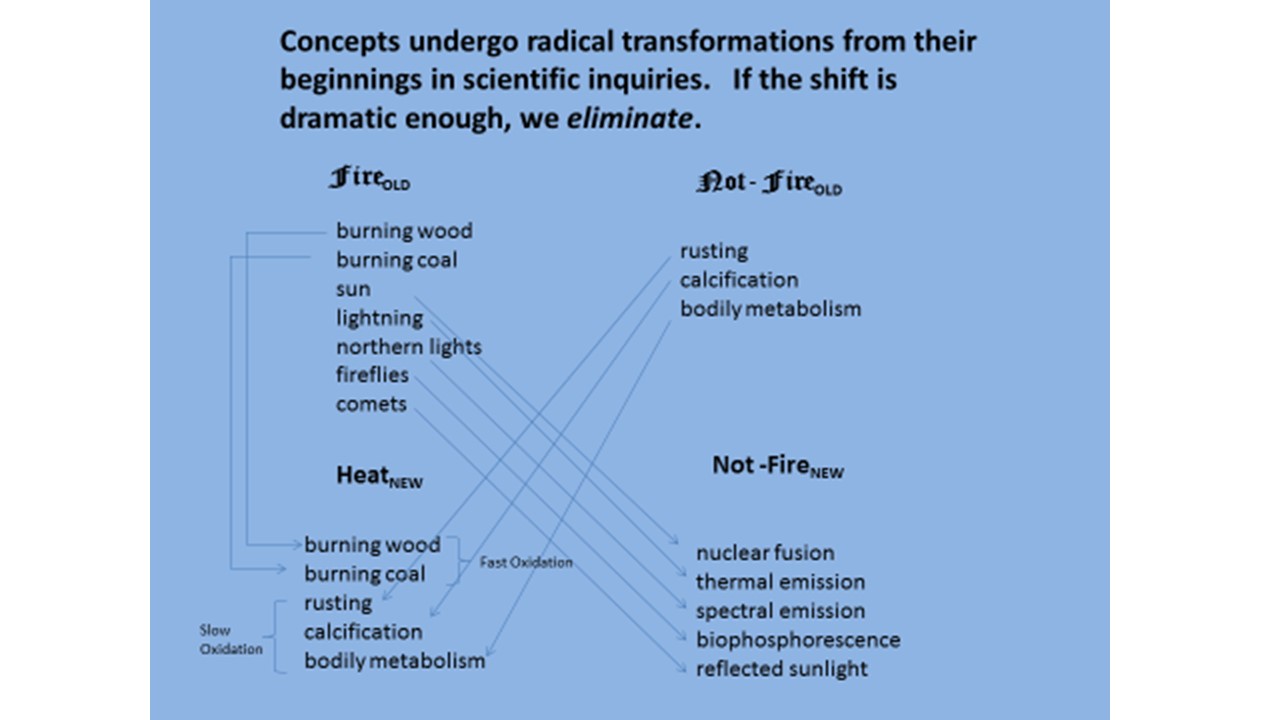
Eliminative materialism- is a position from the philosophy of mind.  It is the “radical claim that our ordinary, common-sense understanding of the mind is deeply wrong and that some or all of the mental states posited by common-sense do not actually exist.”   The eliminative materialist believes that with the expansion of our scientific inquiries, there are often concepts such as “demonic spirits,” or “celestial spheres,” that cease to find a place within our theories.  Some terms, like “heat,” we keep, but only be radically revising what we think the ultimate physical constituents of heat are.  Other terms are too embedded in an old model of reality to be effectively salvaged.  The label applies primarily to a position about minds, but we can see the implications for God and many religious concepts. 

Reductionism—complex systems and phenomena can be reduced and explained entirely in terms of their parts and their causal interactions.  Reductionism in philosophy of mind can be contrasted with emergentism, or epiphenomenalism.  According to these anti-reductionist views, mental states, qualia, consciousness or other phenomena are produced by physical processes, but they cannot be explained entirely in terms of them.  For a variety of reasons, theists are often anti-reductionists, but reductionism itself as a thesis about explaining objects in nature is distinct from atheism. 

Supernaturalism—is the denial of ontological naturalism.  Not all things that exist are natural.  There are some entities, forces, or phenomena that exist beyond the spatial-temporal world that science investigates. 

Theism—the view that God exists.  Typically, the God that is of most interest to atheists and people characterized as theists is the singular, all powerful, all knowing, all good, personal deity who is the central figure in the major western monotheistic religions. 

Evolution—is change in objects over time.  Stars, dialects, and political systems evolve.  In biological species, change can be induced by many factors including but not limited to natural selection.  The suspected asteroid collision that brought on the extinction of the dinosaurs was an evolutionary event, but the extinction was not due to natural selection. 

Natural Selection—is a specific causal mechanism on Earth whereby species evolved over time.  The reproduction of organisms yields heritable variations.  Some of these variations render some organisms better able to survive than others.  Those differences in survival rates produce differences in reproduction of those heritable traits in the next generation. 

I won’t embark on an ambitious argumentative thesis at this point.  In fact, I think that wide positive  atheism, and some forms of ontological naturalism, eliminative materialism, reductionism, and evolution by natural selection are the most reasonable positions given what we know.  But I want to emphasize that an objection to reductionism or to naturalism, by themselves, are not objections to atheism.  Atheism (narrow, positive) is a view about the existence of God, nothing more, nothing less.  That view is compatible with a number of other ontological and epistemological views.  So it will not do to conflate these importantly different positions together and accept or reject them wholesale on the basis of a particular objection to one of them.   

Sunday, January 10, 2010

Know Your Godless Heathens

The discussion between believers and non-believers on the web is filled with sweeping generalities about atheists’ believing this and believing that. Atheists are guilty of it too. Unfortunately, lots of the people making these claims are not taking the time to actually find out what atheists have been arguing. As a result, the characterizations they are giving of atheist positions and arguments have little to do with reality. I’ve presented a long bibliography of the important sources of atheist thought in the last hundred years here:  Atheism Bibliography.  But I acknowledge that that is a substantial homework assignment. Nevertheless, if you are going to take this topic seriously, you need to work your way through the important works on the topic. A physicist couldn’t expect to follow what’s going on if she hadn’t read Feynman, Einstein, and Newton, after all. And a biologist couldn’t get by without Darwin, Mendel, and Gould.

So here’s a much shorter list of some essential works in philosophical atheism from the last 30 years or so. A few are articles, one is my overview of the field that’s going up at the Internet Encyclopedia (It’s posted here:  Arguments for Atheism in the mean time.) And there are several book length topics. If you read these and understand the arguments, you’ll have a good handle on all the big issues and arguments in the field. The Rowe article from 1979 is the watershed presentation of the inductive problem of evil argument (and restated in 2006). To date, the strongest response that’s been given to it is pretty puny: we just can’t be sure if there have been instances of completely pointless suffering out there.

Start reading:

Drange, Theodore (1998b). “Incompatible Properties Arguments: A Survey.” Philo 1 (2), 49-60. On the web here.

  • [A useful discussion of several property pairs that are not logically compatible in the same being such as: perfection-creator, immutable-creator, immutable-omniscient, and transcendence-omnipresence.]

Everitt, Nicholas (2004). The Non-Existence of God, London: Routledge.

  • [Everitt considers and rejects significant recent arguments for the existence of God. Offers insightful analyses of ontological, cosmological, teleological, miracle, and pragmatic arguments. The argument from scale and deductive atheological arguments are of interest.]

Gale, Richard (1991). On the Nature and Existence of God, Cambridge: Cambridge University Press.

  • [Gale gives a careful, advanced analysis of several important deductive atheological arguments as well as the ontological and cosmological arguments, and concludes that none for theism are successful. But he does not address inductive arguments and therefore says that he cannot answer the general question of God’s existence.]

Mackie, J.L. (1982). The Miracle of Theism, New York: Oxford University Press.

  • [Influential and comprehensive work. He rejects many classic and contemporary ontological, cosmological, moral, teleological, evil, and pragmatic arguments.]

Manson, Neil A. (ed.), (2003). God and Design, London: Routledge

  • [Perhaps the best recent academic collection of discussions of the design argument.]

Martin, Michael (1990). Atheism: A Philosophical Justification, Philadelphia: Temple University Press, 1990.

  • [A careful and comprehensive work that surveys and rejects a broad range of arguments for God’s existence. Particularly clear and structured. Many penetrating objections. One of the very best attempts to give a comprehensive argument for atheism.]

Martin, Michael and Ricki Monnier (eds.). (2003). The Impossibility of God. Amherst, N.Y.: Prometheus Press.

  • [An important collection of deductive atheological arguments—the only one of its kind. A significant body of articles arguing for the conclusion that God not only does not exist, but is impossible.]

Martin, Michael and Ricki Monnier (eds.). (2006). The Improbability of God, Amherst, N.Y.: Prometheus Press.

  • [The companion to The Impossibility of God. An important collection of inductive atheological arguments distinct from the problem of evil. God’s existence is unreasonable. The only one of its kind.]

McCormick, Matt. (2009) “Atheism” Internet Encyclopedia of Philosophy. forthcoming: www.iep.utm.edu.

  • [A more detailed survey of the atheism literature and the families of arguments that have become influential in the 20th and 21st century, parallels this bibliography.]

Oppy, Graham (2006). Arguing About Gods, N.Y.: Cambridge University Press.

  • [Main thesis: there are no successful arguments for the existence of orthodoxly conceived monotheistic gods. This project includes some very good, up to date, analyses of rational belief and belief revision, ontological arguments, cosmological arguments, teleological arguments, Pascal’s wager, and evil. He sees these all as fitting into a larger argument for agnosticism.]

Rowe, William (1979). "The Problem of Evil and Some Varieties of Atheism," American Philosophical Quarterly 16, 335-41. On the web here

  • [Very important work. Rowe insists that even if there are some natural or moral evils that God could have had a good reason for creating, there are instances of pointless evil that God could have prevented, then there is no God. And there are instances of pointless evil, such as the isolated suffering of a fawn burned in a forest fire. So it is reasonable to conclude that there is no God. This work provokes an enormous response in the modern literature.]

Rowe, William (2006). "Friendly Atheism, Skeptical Theism, and the Problem of Evil," International Journal for Philosophy of Religion 59, 79–92

  • [Twenty five years after the publication of “The Problem of Evil and Some Varieties of Atheism,” Rowe elaborates on and summarizes the multitude of developments in the argument and his position.]

Schellenberg, J.L. (1993). Divine Hiddenness and Human Reason, Ithaca, N.Y.: Cornell University Press.

  • [Schellenberg argues that the absence of strong evidence for theism implies that atheism is true. Important development of a new argument.]

Thursday, January 7, 2010

Vetting Supernatural Knowledge Claims

I frequently get accused of making the mistake of narrow mindedly demanding empirical proof for things that are not empirical, tangible evidence for the intangible, or applying scientific standards of proof to all knowledge claims when not all knowledge is empirical or scientific.

This sort of comment is typical:

“It always amazes me when materialists clamor for proof regarding spiritual realities in no other than material form. It would be like me asking a physicist for the introspective insight that proves gravity; a plainly ridiculous request. "Spiritual" reality is no misnomer; it is called such precisely because it is spiritual, not material. The distinction here is very real. The means to acquire material knowledge of the cosmos is not the same as one employs to discover spiritual truth. You will never receive a handful of spirit to examine under a microscope, gaze at God through a telescope, or discover a soul on an operating table. The path to spiritual insight will never be found on the outside; it is and will always remain an inner discovery.”

Atheists should reject the switcheroo that is being foisted on them here. Atheists and non-believers should refuse to accept this changing of the topic from "what are the reasons we have for thinking that there is a supernatural being that exists?" to "science and empiricism aren't the only paths to knowledge." First, atheism is not materialism, naturalism, or scientism. At a minimum, the atheist merely denies that there is sufficient justification to believe that “God exists,” is true. In its stronger form, atheism is the view that it is more reasonable to believe that there is no God than to believe or be agnostic. That, in itself, implies or requires no further commitment about the totality of nature. The atheist need not defend an ontological naturalism that insists that no supernatural beings whatsoever exist, although many of us think that is the most reasonable view too. The alleged failings of science, or of materialism are irrelevant to the central question: do we have good reasons to think that God is real?

In looking for an answer to this question, the atheist does not need to insist, at least in principle, that the only way to acquire knowledge of the world is by empirical or scientific means. We can grant that this supernatural, subjective, or non-empirical knowledge is possible. A lot of things are possible, and we’d be foolish to try to argue for their impossibility on the basis of insufficient information.

The problem comes in trying to find some justifying grounds in these so-called internal methods for learning about God. We can allow that it might be possible to acquire some access to another reality or to God through some internal, subjective, personal, or conceptual methods. That’s what many mathematicians believe they are doing when they reason a priori from definitions and axioms to theorems that have sweeping application in the conceptual world of numbers. But what we cannot accept are just any old deliverances of these internal sources without any scrutiny. The other extreme position from a radical empiricism or scientism is having a complete gullibility about these subjective, internal feelings and apply no criteria to them to separate the legitimate from the bogus.

We’ve known since Socrates that in order to have knowledge, a person must have a justified, true belief (Gettier problem notwithstanding). That is, a person does not know something unless first, she believes it, second, it actually is true, and third, she is justified in believing it—she can’t just pull it out of nowhere. And the justification criteria is where these supernatural knowledge accounts invariably fail. In order for a method for producing claims about reality (empirical or supernatural) to be trusted, it has to be reliable. The method must be one that works—that successfully produces true claims about the world. If the method you are using actually produces more false claims than true ones, then we can hardly trust its deliverances. In fact, if it has this sort of track record, like Astrology, or palm reading, or prescient dreams do, then the fact that you arrived at the conclusion by way of that method actually tells us that it is more likely to be false than true. That can hardly be called knowledge. But if the method works—if there’s someone who can gaze into her crystal ball, or read tea leaves, and she can reliably make predictions about the stock market, or find murder victims, or divine tomorrow’s winning lottery numbers—then it’s reliable. And that track record gives us good reason to trust the method and the next deliverance that it produces. Someone may protest that these examples still come down to empirical confirmation. Reliability and the need for some method of discrimination in our methods are not confined to science or the empirical realm, however. If a mathematician can go into a trance and draw out the answers to complicated unsolved problems in the discipline through some mysterious act of divination, we can’t reject that approach outright. The proof is all in whether or not the method works. If her solution to Fermat’s last theorem, or Goldblatt’s conjecture, or whatever, works, and we can check it against some other standard, then she’s building a case for the reliability of her method. And the better the reliability, the more justification it will provide. Then, if the method indicates that the claim is more likely to be true than not, we’re on our way to having knowledge.

So if the theist has another method for learning about the reality of God, we’re prepared in principle to accept that. First issue: if it is not something publicly tangible that can be experienced by the rest of us, what is that method? Is it a voice in your head? A strong feeling? A powerful sense of presence? An overwhelming awareness of a transcendental reality? Something ineffable? Do you come by that knowledge by praying? By thinking? By talking to yourself? Do these ideas come to you when you get yourself into an altered state by fasting? Hallucinogenic drugs? Chanting or meditating? Does it feel like what you figure being overcome by the Holy Spirit must feel like? Do you spin for hours until your consciousness is altered?


Second issue: What are the criteria that you are employing to determine the reliability of this method to acquire supernatural knowledge? How can we tell when the voices or the feelings are lies?

The problem is that we all know that lots of people have lots of these types of experiences that are, for lack of a better word, false. In the course of human history, billions of people have heard voices, felt presences, or divined ideas that just weren’t real. Even the most enthusiastic advocate for internal, supernatural knowledge has to concede that in a lot of cases when people have these experiences, they are bogus. If the Christian advocates this route to knowledge of the Christian God, then he has to conclude that the thousands of non-Christian sects and billions of non-Christians who used that very same method but got different results were mistaken. So just like any other method for justifying a claim, including scientific ones, there must be some way to separate the authentic deliverances of this inner sense from the mistaken ones. What are those distinguishing marks that would allow us to determine the reliability of the method?

Please don’t say that they can only be known privately inside your head too. It can’t be that we (on the outside) can know that your method is reliable because it really, really feels reliable to you. That amounts to a circular proving of the method with the method. Besides, the Sufi mystic, or the Hindu seer both say exactly the same thing about their method for finding (different) ultimate truths about reality. It can’t be the voices in your head that confirm the reliability of the voices in your head, and the feelings of the Holy Spirit can’t establish the reliability of what appear to be the feelings of the Holy Spirit.

What some authors like William Alston and Alvin Plantinga have conceded that person should seek out confirmation of their method outside of their own minds. Good methodology can be distinguished from bad by checking with a community of other believers or experiencers who report having these feelings too. By comparing notes with them, the experiencer can become satisfied that what they are feeling is real.

The problem here should already be evident. If the believer draws the circle carefully and small enough around just those people in their tradition, from their church, or sect, then they might find what appears to be corroboration. But define the community of other-worldly travelers big enough to include the local mosque, synagogue, gurdwara, or shrine and suddenly we find people who are using the very same method to arrive at radically different and logically incompatible results. The history of human religious movements is filled with the near infinite splintering of one group from another over doctrinal and theological disagreements about the so-called one, true meaning of God’s communications. It’s laughable to suggest that the reliability of one’s inner sense of God can be proven by appealing to some consensus among believers that simply does not exist. Proving the reliability of the other-worldly method cannot be a matter of merely checking with your (close) friends.

The problem is made worse by the fact that there is a mentally ill guy on the corner by the supermarket who has lots of powerful, seemingly metaphysically significant ideas springing up in his mind too. The internalist theist has to admit that there needs to be some way to distinguish authentic epiphanies of God and reality from delusions, fantasies, and ideologically driven mistakes. If they have no way to separate them, and just insist that they have some really, really powerful feelings that God is there, what makes their claims any more acceptable to the rest of us than the homeless guy's?

The answer, of course, is that the internalist does not have anything resembling a method and no way of establishing the reliability of their special God sense over all the others. And that’s why we reject their claims to have knowledge this way. The problem has nothing to do with the totality of science or the adequacy of empirical methods to discover all truths. The problem is that so many of these non-empirical methods have produced obvious bullshit for millennia, and we should know better than to just accept some subjective feelings as reliable indicators of a metaphysical reality.

Two points to summarize. First, we should not allow the redirection of doubts about special private knowledge of God to a debate about the methods of science, naturalism, or materialism. That’s all beside the point. The real issue is: what are the reasons we have to think that God is real? Since the subjective realm is notoriously unreliable, it won’t be sufficient to defend internalism by merely insisting that religious belief is subjective and beyond the reach of empirical methods. There have got to be some methods of discrimination or the believer can have no knowledge.

Wednesday, December 16, 2009

Science is Essential to Morality

In my last post, I asked the question, can science tell us what we ought to do. My short answer there was “not really.” I’d like to elaborate and modify that answer. Science is a far better method for answering all of the questions that concern human flourishing than any other approach we have, including religion.

Consider this question: What are the valuable questions to have answered in our efforts to live a good life? And once we have a sense of what these questions are, let’s think about the different approaches we might have to answering them. Here are a number of candidates in no particular order:

How can I live longer?
What will make me healthy?
Which vices am I prone to?
Which virtues are the hardest to obtain?
What are the best methods for achieving virtues and avoiding vices?
Which cognitive practices are best for cultivating happiness and fulfillment?
What sorts of lifestyle choices will produce the most happiness and fulfillment?
What sort of education and treatment will be most effective in my children’s education?
What sorts of treatment and what kind of parenting will do my children the most good? The most harm?
What are the best ways to discourage criminal behavior in myself and others?
What are the relative harms of various behaviors?
What are the benefits of various behaviors?
What sorts of social environments are most conducive to human flourishing?
Which social circumstances are the most detrimental to human flourishing?
What sorts of social relationships do humans need in order to flourish?
What are the most effective means for avoiding and defeating addictions?
What sorts of choices are most effective at preventing addiction?
If we seek to improve the lives of others, where are our efforts most productively directed?
What are the dangers of technological innovations?
How can we best prevent and treat disease?
How can we rectify famines, plagues, droughts, floods, earthquakes, and other natural disasters?
How can we build the best infrastructure for human societies?
What sorts of job pursuits, and working conditions are most conducive to human flourishing?
What are the best methods for establishing public safety?
What are the best methods for education?
What are the most effective methods for rectifying inequalities and bias?
What are the best methods for eliminating human pain and suffering?
What makes humans sick?
Which treatments can cure them?
Which are the best medical treatments?
What harms does poverty do to humans?
How much alcohol is good for humans?
Is smoking a healthy habit?
Do drugs do harms to people?
What are those harms?
Which methods of birth control work?
What sort of family structure and family relationships are most conducive to human satisfaction and success?
What are the differences between people’s perceptions of the truth and the truth?
What are the best methods for achieving mental well-being?
What are the negative and/or positive effects on humans of environmental factors such as air, water, and noise pollution?
Which political systems achieve the high degree of human freedom, fulfillment, and happiness?
What are the effects of various features of an economic system on the welfare of the humans in it?

It seems to me that science is vastly better qualified and demonstratively successful at giving us answers to all of these questions whereas religion fails horribly, or just has nothing to say about most of them. What resources are available to the Christian religion, for instance, for addressing these questions? The Bible is a collection of scattered writings from a variety of Iron Age authors that contains some opinions about some of these matters. But as the idiosyncratic views of just a few under-informed writers from pre-industrial, agrarian cultures, they are of limited use and often just flatly mistaken. Personal, anecdotal opinions about empirical matters are notoriously unreliable, even when these opinions come from wise, experienced sources. We won’t take seriously the claim that the views about these matters in the Bible can be trusted because the authors are channeling some infallible divine source. There are far too many gaps, confusions, contradictions, and flat out mistakes for that to be true. If the Bible authors got their information from some supernatural source, that source has proven himself to be highly unreliable. The musings of a church leader, or the recommendations from a pastor’s sermon aren’t much better since they too are subjective, biased, and anecdotal.

But carefully constructed, double-blinded clinical trials on medications, or large scale, objective analyses of data from scientific investigations give us real, accurate answers. When we gather large amounts of data with methods that are designed to prevent filtering and bias, and then when we evaluate that data actively looking for disconfirmations of a hypothesis using the established principles of sound empirical research, we do a far better job at getting at the truth than any other method.

If you care about human well-being, including your own, it is hard to imagine a single topic where science is not prepared to give you a better answer that is based on the facts. And what is a moral system if it doesn’t take the well-being of humans or sentient beings as its central aim?

Science is absolutely central to informing us about what we ought to do.

Monday, December 14, 2009

Can Evolution Explain Morality?

The standard theist answer is an emphatic no. They’ve repeated the answer countless times without really looking at the evidence. The first problem is that the claim is confused about several different distinctions. Let’s separate some questions:

Can the theory of evolution give us an account of how natural selection might have worked on humans (and other animals) to endow them with a moral sense? Yes. Even since Darwin, people have put forward ideas about how evolutionary forces could have selected for certain kinds of cognitive constitution in early hominids over others. The answer will depend on what we mean by moral sense. Perhaps the question is: Can evolution give us an account of why we care about each other, or why to do good things for each other, why we are generous or compassionate, why we have a sense of justice? Yes, it does. Barbara Kind, Frans de Waal, Marc Hauser, Patricia Churchland, Philip Kitcher, and many others have given careful accounts, supported by empirical observations, of how the process of evolution might have selected for individuals with some behaviors, preferences, and sensitivities and not others. As with any scientific theory, more empirical research and investigation will make progress on figured out which theory best accounts for the facts.

Can the theory of natural selection make us want to be better, more moral people? No. The theory is neutral in this regard. It just tells us what we are. But the process of natural selection does appear to have left us with some very strong desires to be better, more moral people. So evolution has made us want to be moral. But it has also made us favor foods that have very high calorie densities. In the wild, nuts with their high fat content were an important find when food is scarce. But I shouldn’t be following that same preference by ordering another slice of calorie rich cheesecake.

But can divine command theory make us want to be better, more moral people? No, it can’t. What believing that God commands X and forbids Y can do, especially if it is coupled with a threat of punishment or the promise of reward, is give you some incentive to engage in more behaviors that appear to be moral. But acting for the sake of reward or out of a fear of punishment isn’t moral behavior. That’s save-your-ass behavior. That’s utterly selfish, amoral behavior. Moral behavior requires other directed, other concerned, non-self interested motivation. Kant argues that in order for an act to be morally good, it must arise from the right sort of principled motivation that recognizes the autonomy and value of another person as a self-governing being. Real moral actions are one’s that transcend concern about yourself and that recognize others as beings who make choices, employ reason, and have freedom. Following orders from God either because he issued them or because of fear of punishment actually thwarts individual responsibility, freedom, and reason. Even if God commands that we act in selfless ways that acknowledge the rational autonomy of others, doing so isn’t moral if your motivation is that God commanded it.

Socrates showed us in the Euthyphro that whatever God commands, the question of whether that commandment is the morally right thing to do is a completely separate matter. Deciding either to do what God commands (because you are free) itself is a decision that concludes “What God commands is good.” And that is a moral decision that must be made on the basis of grounds other than the mere fact that God commanded it.

Can evolutionary theory tell us what we ought to do? Not really. It can tell us what we are and how we are built. It can tell us what sorts of behaviors are favorable to survival, and so on. But whether or not you ought to do any of the things that you are built to do is a separate question. You’ll have to have some better reasons to do it than the mere fact that we are biologically inclined to do some things rather than others. Biology may have endowed us with inclinations that themselves are immoral. This is the infamous is-ought problem. But the mistake is thinking that this problem is confined only to naturalized accounts of ethics. The is-ought problem is everyone’s challenge, especially for those that think morality comes from God.

Thinking that God wants us to do some things and not others can’t tell you that you ought to do it either. First, the diversity of religious views and the countless instances of doctrinal in fighting over every moral and religious question makes is obvious that there are no clear answers about what God wants us to do, especially among the people who are most convinced that we should do what God commands. Second, even if someone (mistakenly) concludes that God clearly wants us to do this and not that, whether or not you ought to do what God commands remains to be seen. It doesn’t become something you ought to do merely from the fact that God commands it, or you’d be busy right now committing genocide against the Midianite men, women and boys, but saving 32,000 virgin girls for your own use (Numbers 31), or wiping out the Hittites, the Girgashites, the Amorites, the Canaanites, the Prizzites, the Hivites and the Jebusites. (Deuteronomy 7 1-2). You’d be fulfilling the command to perform human sacrifices (Leviticus 27: 28-29, Judges 11:29-40, II Samuel 21: 1-9.) Or you’d enslave other humans (Exodus 21: 2-6). Or you’d be following God’s commandment to punish witchcraft, heresy, violating the Sabbath, adultery, blasphemy, and back talking your parents with death. (Exodus 22:20, 31: 14-15, Leviticus 20:10 and 24: 16, and Exodus 21:17). If women seriously thought that we ought to follow God’s commands, then they’ he’d this one: “Wives, submit yourselves unto your own husbands, as unto the Lord. For the husband is the head of the wife. . . Therefore as the church is subject unto Christ, so let wives be to their own husbands in everything.” (Ephesians 5:22). (I wish my wife believed that, then I could order her to go make me a sandwich right now.)

Moral philosophers have offered us a number of powerful theories about what we ought to do based on reasoning about morality. These accounts do have the potential to show us what we ought to do. Here are very short statements of just ten of them. There are many more and there are in depth background discussions of each in the authors’ works. One point to note is that none of them mention God. Another is that these philosophers are making an earnest effort to give a reasoned, principled, consistent, and convincing account of why we should do some things and not others.


1. Treat others as ends in themselves, never as mere means. (Kant)

2. A man [should]be willing, when others are so too, as far forth as for peace and defense of himself he shall think it necessary, to lay down this right to all things; and be content with as much liberty with others as he would allow them against him.(Hobbes)

3. “If a being suffers, there can be no moral justification for refusing to take that suffering into consideration. . . . The principle of equality requires that its suffering be counted equally with the like suffering of any other being.” (Singer)

4. Eudaimonia, or flourishing, for humanity can only be achieved by acquiring virtue with regard to that which sets us apart, or our capacity to guide our own behavior by reason. Fulfillment can be achieved by living well according to this essential nature over the span of a whole life. (Aristotle)

5. Act according to that principle that will promote the greatest happiness for the greatest number.(Mill)

6. Only have aversion for those things that are in your control If you are averse to sickness, or death, or poverty, you will be wretched. . . .If you desire any of the things which are not in your own control, you must necessarily be disappointed; and of those which are, and which it would be laudable to desire, nothing is yet in your possession. (Epictetus)

7. “Man first of all is the being who hurls himself toward a future and who is conscious of imagining himself as being in the future. Man is at the start a plan which is aware of itself, rather than a patch of moss, a piece of garbage, or a cauliflower; nothing exists prior to this plan; there is nothing in heaven; man will be what he will have planned to be." (Sartre)

8. It is impossible to live a pleasant life without living wisely and honorably and justly, and it is impossible to live wisely and honorably and justly without living pleasantly. (Epicurus)

9. Each person is to have an equal right to the most extensive basic liberty compatible with a similar liberty for others. And social and economic inequalities are to be arranged so that : a) they are to be of the greatest benefit to the least-advantaged members of society b) offices and positions must be open to everyone under conditions of fair equality of opportunity (Rawls)

10. Refraining mutually from injury, exploitation, and putting one's will on a par with others, may lead to a certain degree of good conduct among individuals. But to make it a fundamental principle of society is a will to the denial of life, a principle of dissolution and decay. (Nietzsche)

Many people think that it is a serious blow against atheism and evolutionary accounts of human origins that they cannot explain morality. The problem is that in many regards, evolutionary theory does explain morality. But even if moral behavior was a mystery from an evolutionary standpoint (it isn’t), we still wouldn’t have any grounds to prefer a divine explanation for moral behavior. Adding God to the discussion just doesn’t do any explanatory work for us in helping us understand what is right and wrong, what the human moral conscience is, or what we ought to do. We will all encounter challenging, morally complex situations. And in order to get through them, we will have to think about the reasons we have for various actions. And we will have to decide which reasons are better and which are worse. Thinking that God commands something won’t help us decide if it really is morally good to do that. That is, no one can escape the burden of moral responsibility for their actions. And the only tools we have for solving those dilemmas are our powers of reasoning. Some of the very best reasoners among us about moral matters have been philosophers advancing theories of morality. Those accounts do much more towards answering the question of what we ought to do. And they can supplement the evolutionary accounts that we are developing about what sorts of creatures we are. The answer to the lead question is that evolution and philosophy can explain morality, but appeals to God cannot.

Saturday, December 12, 2009

Perpetual Motion Machines and an Argument Against Agnosticism

For decades, the patent offices have been besieged with applications for patents on perpetual motion machines, anti-gravity devices, and other kooky contraptions. Eventually the offices in the U.S. and Britain had received so many and had wasted so much of their resources investigating them, they made a policy that they would not consider any application for a perpetual motion machine patent unless the author could produce a working model.

We could say that the offices migrated from being agnostic about their possibility to being defeasible atheists about them. The laws of physics are not completely known, and we could always be surprised, but countless failed attempts to produce such a machine and their knowledge of the laws of thermodynamics have made it reasonable for them to conclude that such a thing is naturally impossible. I also think we can agree that this conclusion is eminently justified and for them to remain agnostic about the existence of such a device would be silly, unnecessarily cautious, and disingenuous.

We’re in similar position about God. Agnostics have the view that they don’t know whether or not God exists. So the ordinary agnostic acknowledges that none of the various cases that are often presented for the existence of God is sufficiently compelling. The question is, in an epistemic situation where there is no compelling evidence for the existence of a thing, what are the circumstances that warrant deciding that no such thing exists versus merely suspending judgment about it.

Our situation is very much like the situation with regard to perpetual motion machines. We have countless examples of gods that people have thought were real, but turned out to be mistakes. See 500 Dead Gods. We have a good understanding of what is often really going on in those mistaken cases. People are subject to enthusiasm. They are prone to make mistakes. A variety of psychological phenomena seem to contribute to the occurrence and powerful character of religious experiences. Science has offered us natural explanations that supplant the divine explanations. And so on.

Furthermore, like the perpetual motion machine, the God hypothesis, if true, would fly in the face of countless other physical facts that we know about the world. We have never been able to corroborate a single instance of an immaterial soul that exists without a body. There has never been a single observable case of a consciousness, human or divine, that was able to exist without a functioning brain and nervous system. In every case where a supernatural, spiritual, or spooky cause or entity has been alleged to be real, our investigations have found nothing. Prayers don’t work. Nature is causally closed such that events within it are always precipitated by other physical causes.

There are things we do not know, of course. But there is every indication that we will continue to uncover the physical, mechanical, chemical, and biological causes for those things with empirical science just like we have done with everything else. Given what we do know about nature, discovering that there is an invisible, being with a consciousness that exists beyond the natural realm and who interacts with the natural realm would be about as plausible as finding out that the moon really is made of green cheese. We can’t say that such a thing is deductively impossible, but it is completely absurd. And someone who insisted on being agnostic about the possibility is being only marginally less irrational than someone who insists that it is true because they have a magic book that says so.

Being agnostic when the evidence for God is so poor and the evidence in favor of naturalism is so good amounts to a sort of ad hoc foot dragging. That same agnostic would never claim that the only reasonable position is to suspend judgment about a cheese moon, or invisible elves, or Thor, or Santa. In order for agnosticism to be justified in such a situation, there must be some evidential considerations that elevate the remote possibility into the range where the claim is nearly as likely to be true as false. The mere possibility that it is true never justifies treating it as a live enough hypothesis to warrant suspending judgment. There must be more going for the claim before we can give it that sort of respect.

So if atheism about Sobek, Paluga, Thor, Gefjun, Krakus, and all the others is justified, then which hypothesis is left standing and what are the considerations that boost it up out of the class of already rejected ideas? If, against all the odds, you’ve got a perpetual motion machine then by all means let’s see it. Otherwise, the only reasonable position to take is that no such thing exists.

Monday, December 7, 2009

What’s Left to be Agnostic About?

Larry Brand, a documentary film maker, just interviewed me for a film he’s making about atheists. Our discussion got me to thinking about agnosticism. Here’s a clearer statement of my view of it than I think I’ve given of it before.

There are a lot of thoughtful people out there who claim to be agnostic about the existence of God. They will acknowledge that many of the more evangelical and traditional conceptions of God do not make sense. They are not comfortable with the more literal readings of various religious texts or with a strongly anthropomorphic god because they acknowledge the host of problems associated with that position.

But as they see it, there is still a live possibility lingering here that the atheist has been too quick to dismiss. It’s the idea of an absolute ground of being, a source of meaning, a force, a power, or something that exerts influence on the universe with some purpose in mind. It is something that is greater than us, and it is more than can be explained or understood in merely naturalistic or material terms. We’ll call this a supernatural force, or SF. And the omni-God that so many people believe but that this agnostic doesn’t accept is the OG.

First, we should note that we’re not really talking about any sort of recognizable belief in God any more. We’d be hard pressed to even call a belief in an SF a kind of theism. In mainstream religious movements in the West, God has (at least) five essential features. He’s all powerful, all knowing, all good, there’s just one of them, and he’s a personal, conscious being. This last one is the most important for this discussion. Traditionally, God is anthropomorphic—he has a mind or thoughts, he has a plan, and he forms personal emotional and loving relationships with humans. And it’s really this aspect of God that the SF agnostic has moved the furthest away from. This is probably because to the extent to which we endow God with personal, caring, teleological, and conscious motives we make it harder and harder to reconcile that God with the facts. In many people’s minds, suffering, evolution, randomness, and the relative unimportance of humans in the big picture seem to indicate that the world just doesn’t have one of those sorts of beings in it. If it did, there are too many things about the world that would be different. So the SF agnostic has, more or less, conceded the atheist’s point about the sort of God that the vast majority of humans believe in. The SF agnostic is actually an atheist about God, Allah, Jehovah, Zeus, Thor, Sobek, Puluga, and all the rest. She only has reservations leading to suspension of belief about some much more nebulous, non-traditional and non-anthropomorphic thing. If she and the wide atheist are disagreeing about anything, it is about the conditions under which it is reasonable to suspend judgment about a hypothesis vs. simply disbelieving it.

We should allow that some of the difference in epistemic policy here can be legitimately due to different personal preferences. Experience may have led one person to want to be more cautious about lending her assent (or dissent) to hypotheses and generally taking her time in gathering evidence and formulating opinions. While another person may have more of a shoot first, ask questions later approach and be less inclined to suspend judgment about anything unless some relatively specific conditions are met. But if the former person’s policy leads her to think she should be agnostic about Zeus, Sobek, and Gefjun (the Norwegian goddess of agriculture), instead of simply disbelieving them, then she’s being too skittish, unrealistic, or just pretentious. And if the latter person is inclined to just reject everything unless some substantial evidence can be produced in its favor, then he’s being thoughtless and injudicious.

Personal preferences aside, what should it take for a hypothesis to warrant a serious agnosticism? I cannot be merely that it is might be true or it is some conceivable possibility. There are a host of other things that are possible, but reasonable people are not agnostic about them: elves, Santa, the Tooth Fairy, and Chupacabras. It is possible that the Holocaust didn’t happen, or that opening an umbrella indoors is bad luck. But it would be silly to be agnostic about any of these on the grounds that they are possible. In order to warrant a considerate agnosticism, there must be more in favor of a claim. There has to be at least enough evidence in its favor to elevate its likelihood from the merely possible into a range where it could turn out to be true. If the probability that a claim is true ranges from 0 to 1, and the tipping point from probably not true to probably true is .5, then surely the reasonable range for agnosticism for a hypothesis is in the vicinity of .5. Let’s just stipulate that it’s .4 to .6. Greater than that and you’ve got grounds to believe it, and less than that you should disbelieve it. You wouldn’t assign a .5 probability to the existence of Santa, or to the claim that wearing a raw steak hat wards off illness. Those are probably way down in 0 to .1 range. And you would assign a very high probability to the claim that Barak Obama is the President of the U.S.

So what does it take to elevate a claim into the .4 to .6 range? The agnostic we are considering has granted that the anthropomorphic, traditional conceptions of God that so many other people believe in are not real. So those fictions, and those people’s beliefs in them shouldn’t count as someone boosting the supernatural force hypothesis up into the suspension-of-judgment range. The widespread beliefs in Santa, or ghosts, or the view that having sex with a virgin will cure HIV don’t do anything to make those claims even slightly more likely to be true. So widespread belief in an OG shouldn’t influence the probability that we assign to an SF.

This hypothesis will seem ad hoc, nevertheless, I’m going to put it out there because I think it really is at the heart of agnosticism that some people claim to subscribe to. Some agnostics are actually people who want to be believers, but they just can’t bring themselves to disregard all the counter indications.

To be honest, I think that what happens for a lot of agnostics is that they started out believing in an OG. They were raised religious, participated in religion with their friends and family, and they even enjoyed it or found it fulfilling. But as they explored the question intellectually they came to acknowledge that really what’s entailed by those religious doctrines can’t be true. They couldn’t reconcile the religion that they knew with the rest of what they know about the world. So they, perhaps grudgingly, gave up on that notion. But a desire to be religious in some form lingers, and there is still a great deal of appeal in the idea of some transcendent, supernatural force that holds out hope for something more than just matter and the reality we are faced with here. So these agnostics back off of the traditional notion of a thundering, judging, Biblical creator God but hold some optimism for an SF. They remain agnostic about that possibility because that idea doesn’t have the glaring inconsistencies that sabotaged traditional belief for them. If it is these sorts of personal desires that have led to a person’s elevating the possibility of an SF to the agnostic range, then I think this sort of agnosticism is ill-founded. If what’s really going on in their heads is that they wish they could believe in God, but they can’t bring themselves to buy into the deeply problematic being who is the center of belief for so many other people, then they don’t really have any evidence that would warrant suspension of belief about an SF; they are, more or less, religious believer wannabees. Subjective motivations like desire, need, hope, or psychological affect should not be permitted to influence the objective probability value that we assign to some claim about reality. My wanting to win the lottery, no matter how bad, doesn’t actually change the odds in the slightest—Oprah and The Secret notwithstanding.

Maybe if we consider a paradigm case of suspension of belief about some other hypothesis it can shed some light on the appropriate circumstances for agnosticism about God. Not everyone will agree with me, but the existence of intelligent alien life seems like a hypothesis that it would be wise to be agnostic about. It is certainly possible that it exists, and there are many considerations that lead us to think that the probability could be much higher than zero. We know life developed in our case, and given the enormous numbers of stars and planets in the universe, those conditions could be found in many other places. But there is too much we don’t know about the prevalence of planets with life conducive conditions. Even when life develops, it may be extraordinary for it to develop into intelligent life. Evolving to the point where they can engage in space travel or interstellar communication may be very, very difficult even if life turns out to be relatively common. Some thoughtful people conducting the search for extra terrestrial intelligence are divided about the issue. And so on.

What does this example show us? The idea can’t be merely consistent with what we know. If we make goblins undetectable, or give Santa a cloaking device, those hypotheses can be made consistent with everything else we know. There has to at least some plausibility to the hypothesis such that it could fit in with the known facts. We need to have, at least in outline form, a sketch of how that thing could be true and how it might dovetail with the rest of what we know about the world. We can anticipate several different ways in which aliens could fit in the world we know. Xeno-biologists (how about that for a cool job?), physicists, chemists, and cosmologists can give us a number of plausible accounts for how they could exist (not merely that they might possibly). Liquid water does appear to occur naturally on other planets in the universe. And some of those planets and stars appear to be the right temperature, age, and type to support life. The molecular construction of life could take a number of different forms, and so on. All of those considerations lead us to give it higher initial probability than we would to an invisible elf hypothesis.

So if we can take a lesson from the example, what the SF agnostic owes us is some account of an SF that fits comfortably with the rest of what we know or experience. Or put less confrontationally, if order for the SF hypothesis to warrant agnosticism, there must at least be enough evidence in its favor and some account of how the existence of such a thing could comfortably fit in with the rest of what we know.

What do we have regarding an SF that might lead us to give it this status? We’ve already seen that it cannot be the prevalence of belief in an anthropomorphic God among other people. And it can’t be our hoping that there is something else that leads us to give the real thing a greater probability. Are there phenomena, experiences we have, or other evidence that could be explained by an SF? Here the SF agnostic may say yes. She may point to internal phenomena: human consciousness, feelings of the sublime, transcendent experiences, our moral facilities, or religiousness. Or she may point to external phenomena: the advent of life on Earth, fortuitous circumstances, or the alleged fine-tuning of the cosmos.

But it cannot be merely that it is possible that these things are brought about by an SF that will warrant agnosticism about it—they could possibly be the work of Sobek too. There has to be sufficient evidence in favor of the SF hypothesis over the others to elevate it to the neighborhood of .5.

Do we have that? Here’s why I don’t think we do. We have many natural (non-supernatural) hypothesis that are either the probable explanation of each one of these phenomena, or we know enough about them to know the vicinity where the natural explanation will be found. None of our substantial efforts to understand these phenomena and others in natural terms have pointed in the direction of a supernatural explanation. Quite the contrary, in every case where we thought there was some supernatural force or cause at work, investigation revealed a natural one. There are no ghosts, no evil demons, no spiritual possessions that cause disease. The alleged miracles that we have investigated have turned out to be the result of human fallibilism, enthusiasm, or deceit. 10,000 supernatural hypotheses have given way to natural explanations.

So the burden on the SF agnostic is to point to evidence that would warrant our not lumping the SF hypothesis in with all the rest of the non-natural forces or beings that have failed. The world, all of it, looks to be a natural place where everything can be accounted for in natural terms. What’s left to be agnostic about?

Saturday, December 5, 2009

Can't Be Moral Without God? Wrong.

Many people believe that in some fashion it is not possible for a person to be moral without God. So the charge that atheists are somehow lacking morally in this regard is brought up again and again.

There are a lot of confusions embedded in these discussions coming from both sides. We need to get clear on what the claim might mean and sort out some ambiguities. The first ambiguity concerns whether the claim is to be taken in an epistemological sense or an ontological sense. That is, do they mean that if a person doesn’t believe in God, they won’t be moral, or that if God does not exist, then morality would not exist? The second ambiguity concerns what “be moral,” means here. Does it mean act in a morally decent, law abiding manner, or does it mean ground their moral decisions on the right moral considerations?

So that gives us several different ways to interpret the sentence. At the risk of being tedious, let’s deal with them one by one. Is it true that unless a person believes in God, then they won’t act in a morally decent, law abiding manner? No. There are a billion or so Buddhists on the planet, and several hundred million atheists, just for starters, who do not believe in any sort of divine being, but it would be absurd to suggest that none of them act in a morally decent, law abiding manner.

Is it true that unless a person believes in God, they won’t ground their moral decisions in the right moral considerations? Again, this can’t be true either. Kant, Mill, Rawls, Aristotle, and many other respectable, plausible moral theories give accounts of how moral decisions should be grounded without any requirement for the actor to believe in God. If the someone wishes to defend this claim, then they will need to argue that none of the widely respected, studied, and emulated moral theories that have been developed in history are right and that no acts that are done in accordance with them are moral. That seems like an extraordinary and implausible position to take. It seems that at least one of these must be at least as plausible as divine command theory. In fact, the vast majority of expert moral philosophers have taken them all to be superior theories.

Is it true that unless God exists, then no one would act in a morally decent, law abiding fashion? It’s hard to know what the critic is getting at if they say yes. They might be thinking that it’s only the fear of God or respect for God’s commandments that makes people behave themselves. But again, this is myopic. There have been billions of people in history who don’t believe, don’t know about, or who have taken no note of God in their deliberations, but they have behaved morally. So it’s not believing that God is present that keeps people in line. Whether God exists or not, there are people who think he does not and who behave morally. So it seems implausible that his existence or non existence makes any real difference in their behavior.

Is it true that if there were no God, then no one would ground their actions in the right moral considerations? We can imagine that the critic would insist that this one is true. Sure, lots of people do ground their actions in other, non-God considerations, and they also behave in what appears to be a morally decent manner. But in fact, says the theist, none of their actions are based on the right considerations. He might insist that if there were no God, then there would be no sense of morality in humanity, or humanity would have never developed an awareness of a moral dimension in their lives, or our natures would be radically different. God is responsible for our capacity to act in moral ways, so if there were no God, then there would be nothing like morality at all. And then this moral capacity, that can’t be explained any other way is employed as evidence for the existence of God.
The problem with this position, of course, is that it is danger of being circular reasoning. How is it that the theist came to know that the moral capacity in humans could have only come from God. It’s embarrassing if the answer is “from God.” It’s even worse if that moral capacity, that God told them came from God, is then used as evidence that God exists. God tells me that only God can provide us with morality. My morality proves that God must be real.

The critic might try to go deep here and insist that even though many moral systems like Aristotle’s or Mill’s make no explicitly appeal to God, if it hadn’t been for God endowing humanity with a capacity for moral action or a moral sense, Aristotle and Mill would have had anything in human behavior to theorize about. They wouldn’t have even been aware of any moral dimension to our lives. But this argument also seems to beg the question, and it’s very hard to see how one might defend it, particularly since we have some plausible alternative accounts of how morality arose in humanity. Evolutionary biologists have given us a large body of evidence now that indicates that evolution built us, along with lots of other species to be moral. We observe proto-moral behaviors in all sorts of animals now, and we have a number of theories that about why evolution might have selected for altruism, sympathy, cooperation, and other social instincts.

It’s possible that the capacity for moral behavior that we find in ourselves came from God, but the critic needs to argue that that’s the only possible source it could have come from. And that much stronger claim is very hard to give a plausible argument for.
So it looks like whatever they mean by the claim that you can’t be moral without God, it can’t be right. Some of the things that sentence might mean are obviously false, and other interpretations fall into circularity or have to argue for some claims that can’t fit with the facts.

Wednesday, October 21, 2009

Guilty!

Suppose that you have been falsely accused of committing a crime, say, a murder, that occurred many years ago. There is very little evidence connecting you to the murder except the testimony of 4 people named Mike, Monty, Larry, and Jacob. Your defense attorney puts them on the witness stand and interviews them one at a time. During the questioning several important facts about their belief that you committed the murder are revealed. It turns out that none of the four actually saw you commit the murder. They’ve never even met you before. But each one of them admits that they heard some stories from some other people that you committed the murder. And it cannot be established that these other people were witnesses either and they are not available to be questioned. None of the 4 knows how many times the story was repeated or passed around before they heard it. They heard that a lot of people were witnesses to the murder, but again, none of those people are available and it is not known who they are. It turns out that the murder happened 30 years ago and they heard about it because the accusation that you did it has been talked about and remembered by these other unavailable people during all these years.

It also turns out that Mike and Larry got the story from Monty. They believe that you did it entirely on the basis of Monty’s telling them that you did. Furthermore, when the attorney tries to get the details straight about what happened at the crime scene, none of them tell the same story. The important details (that they all got from other people) are different in every case.

At one point, the prosecution puts a man named Perry on the stand and he affirms that you did it too. But he admits that he wasn’t there and he did not see it. Rather, he had a powerful vision during a trance while he was walking down the street one day and a voice he heard told him that you committed the murder.

The prosecuting attorney makes an attempt to assure the jury that you are guilty because there are lots and lots of people out there who believe it because they heard it from Mike, Monty, Larry, Jacob, and Perry. But the judge prohibits it because “Everyone knows that it is true,” is not an admissable form of evidence in court. But it never becomes clear why the judge allowed the hearsay evidence of the 5 men to be heard in the court in the first place.

The prosecuting and defense attorneys close their case. And the jury, all being good Christians, promptly convicts you of murder and sentence you to death.

If you haven’t figured it out: Mike, Monty, Larry, Jacob, and Perry are all Matthew, Mark, Luke, John, and Paul, respectively.

Does it sound like fair grounds upon which to convict a person?

A murder charge and conviction are no less important in their impact on a person’s life than the changes that Christian’s believe we should enact in our lives for Jesus. If it is not reasonable to convict a person of murder on these grounds, it is no more reasonable to believe that 2,000 years ago a person came back from the dead on similar grounds, especially since it matters so much.

Suppose that we debriefed the jury after the trial and asked them about their decision and when we raised doubts about what they had done, some of them said things like, “Well, I know that the evidence was really sketchy, but in the end you just gotta have faith. And I have faith in my heart that he did it and deserves to go to prison for the murder.” Would that make the decision better or worse? Some of the others said things like, “I was raised Lutheran and we were always taught that he did the murder. That’s just the way I was raised. So when it came time to decide, I just went with that.” One of the other jurors said, “Yeah, the evidence for his guilt was really weak. But I just figure that it’s a good bet to find him guilty anyway. I mean, it could be wrong, but you never know—he might really have done it. There’s a 1 in a billion chance that he did. So if I convict him, then I will have done the right thing and justice will be served.” Another juror said that he just went along with the others to keep his grandmother happy.

There will be complaints about this story, no doubt. “The cases aren’t the same because in this case the person is accused of something bad, a murder, and it is a false accusation. But Jesus’ resurrection is true.” There are two problems with this response. The murder charge is analogous because it and the Jesus belief are both decisions of great import. What matters is that what is decided on the basis of the information at hand will have an enormous impact on a person’s life. There’s no question that believing in Jesus does have a radical effect on people, and there is no question that millions of believers think that it should have that effect on you. If believing in Jesus seems like a minor, trivial matter to you, then perhaps you should rethink the implications of it. But even so, believing something irrationally is irrational, no matter how big or little the belief is.

Furthermore, if the source of a person’s conviction that Jesus’ resurrection happened is the words of Matthew, Mark, Luke, John, and Paul, then complaining that the murder case is different because it is a false charge is begging the question. The point is that we don’t know whether or not Jesus came back from the dead, except on the basis of their words, so we can’t then assert that we are sure their words are accurate because Jesus came back from the dead.

There is a disanalogy here that actually makes the case for Jesus worse. To make the murder trial closer, Paul would have to tell his vision story about 20 years after the alleged murder. Then 10 to 20 years later, Mike, Monty, and Larry would come to the courthouse and give their stories. Then a full 90 years after the alleged murder, Jacob would show up and give his account of the murder.

But we must assume that the Christians on the jury would still be untroubled by the problems in the case for your guilt and when they promptly convict you on the basis of it, we should find them guilty of nothing unreasonable or unfair in their decision.

Tuesday, October 20, 2009

Eyewitnesses

Go here and watch this video. Focus your attention closely and try to count the number of times that the team of people with black shirts passes the basketball:

Basketball passing

Eyewitness testimony is, of course, overrated. We have heard that it is not reliable many times, but we may fail to appreciate just how bad it can be. Daniel J. Simons, a visual cognition researcher at the University of Illinois has created a number of experiments with shocking results. In the video above, a group of people in white and black shirts pass a basketball back and forth while rapidly changing position. Subjects are instructed to watch the video and keep track of the number of times one of the teams exchanges the ball. During the video a man in a gorilla suit saunters across in front of the basketball players, looks at the camera, beats his chest, and then walks off screen. An amazing 56% of the test subjects, who were focusing their attention on the ball passing behind the gorilla failed to even notice the gorilla standing in plain sight. People who are shown Simons’ video and instructed to do the same are typically incredulous that the gorilla was there until they are shown the video again. Show the video to someone else and tell them to count the number of times the black shirt team passes the ball.

Simons, D. J., & Chabris, C. F. (1999). “Gorillas in our midst: Sustained inattentional blindness for dynamic events.” Perception, 28, 1059-1074.

There were 30 to 100 years that passed between the alleged events surrounding Jesus’ death and when they were written down by the authors of the Gospels who based their accounts on hearsay sources. The stories passed through an unknown number of people and repeated an unknown number of times before they were written down. But suppose that on the best case scenario, the authors actually spoke to someone who claimed to be a witness to the resurrection of Jesus. If we don’t notice a man in a gorilla suit jumping up and down in front of us as it is happening, how reliable is our recall going to be about something we think we saw 30 years ago?

Thursday, September 17, 2009

The Case Against Christ--draft of a book proposal

I'm working on a book manuscript. That's why the blog's been pretty quiet. Here's a draft of the proposal. Not the most entertaining thing I've written, but important. I'll take constructive suggestions. But please don't quote the Bible to me.

The Case Against Christ: Why Believing is No Longer Reasonable

Table of Contents
Introduction: Christianity and a Dissenting Voice
Chapter 1: The History of the Jesus Story
Chapter 2: Salem Witch Trials
Chapter 3: Transmission and Reliability
Chapter 4: Abducted by Aliens
Chapter 5: Irrationality
Chapter 6: The Problem of other Religions
Chapter 7: Would God do Miracles?
Chapter 8: The “F” Word
Chapter 9: Conclusion

Projected book length is about 70,000 words. I have drafts of the Introduction, Chapter 1, 2, 3, 4, and 7.

Scope of the Book

The goal of the book is to present a number of arguments and considerations that raise substantial challenges to being Christian. More specifically, it focuses on questions about the reasonableness of believing that Jesus was a divine being that was resurrected from the dead 2,000 years ago. My central argument is that believing that Jesus was resurrected from the dead on the basis of the evidence available to us—primarily a small group of testimonial stories recorded in the Gospels—is inconsistent with our other conventions concerning belief and evidence. I will present a number of other ordinary cases where we have a body of comparable evidence, yet we would reject the analogous conclusion. In fact, there are numerous cases where we have better evidence—both in terms of quantity and quality—but we would not accept a similar supernatural conclusion. Several other considerations fortify this argument: problems with the transmission and reliability of the Jesus story made clear by probability theory, modern developments in epistemology, and recent empirical research psychology also demonstrate that we have insufficient evidence to make believing the Jesus story reasonable. Additional discussions of other religions, miracles, and faith will complete the book.

Full Description

Introduction: The book begins with a two discussions to set the stage. First, I give a summary of the state of Christianity today—how many people are Christians? What types of Christianity are prevalent? And what do they believe?
Not only is Christianity, particularly in the United States, a dominant cultural, political, moral, and spiritual institution, but a set of cultural conventions have developed that suppress open, objective critical thinking about it. We are averse to directing critical evaluation at religious beliefs or the grounds on which people build them. Concerns about toleration, respect, and freedom of religion have led us to the point where even asking questions or raising doubts about the wisdom of being a religious adherent are met with protest. Our sensitivities have arisen in part from a confusion of religious affiliation with ethnic identity; raising doubts or criticizing someone’s religious beliefs feels offensive the way ethnic criticisms do, and they are wrong for similar reasons. As a result, doubters are considered angry, intolerant, spiteful, or strident. For example, the majority of the negative responses to the works of the New Atheists—Richard Dawkins, Sam Harris, Daniel Dennett, and Christopher Hitchens—have attacked them on just these grounds. In an atmosphere where critical inquiries about Christianity are stifled, poor thinking has run amok. Unfettered religious belief thrives in this indulgent environment.

The context has made it difficult to ask and answer a vital question: do the people who are the typical believers in the United States, 21st century adults with a modern education, and with the benefits of all the knowledge at our disposal, have adequate grounds to justify our believing that Jesus, the cornerstone of the Christian religious tradition, was a divine being who performed supernatural acts? In preparation for the arguments I will give, I plead for openness about the possibility that Christianity is built on a mistake. I make some suggestions about the relationship of openness to idealized rational belief formation, and I begin to outline some principles of critical thinking. My goals are to dissuade people from accepting the Jesus story on the basis of the information that we have, instill a desire to be a better critical thinker, and outline some principles and procedures for being more rational, particularly about religion and Christianity.

Chapter 1: The History of the Jesus Story
In order to address the question of reasonable belief in Jesus, Chapter 1 will give a general summary from the mainstream scholarly consensus of the history and character of the documents that relay the Jesus saga to us. The Gospels were written 30-90 years after the alleged events of Jesus’ death. The writers based their accounts on reports from unknown verbal sources with an unknown number of links to the alleged eyewitnesses. In the next 200 years or so, these accounts were copied while other Christian writings proliferated. Eventually the book that we know as the Bible was sifted from these writings and many of the other sources were lost, destroyed, or deemed heretical. I draw on prominent scholarly works to give an accurate picture of the relevant events in the history of the information that will be used in later chapters. I also make a novel application of the Texas Sharpshooter Fallacy to a common view about the nature of the modern Bible.

Chapter 2: Salem Witch Trials
The general question facing us is under what conditions do we have a body of historical evidence that might lead us to conclude that some supernatural, miraculous, magical, or otherwise extraordinary event has occurred. Many Christians believe that the evidence we have concerning Jesus is sufficient to cross this threshold. The problem is that there are numerous examples in our lives where a comparable level of proof has been met (or exceeded!) but we reject the analogous conclusion. The accumulated body of evidence concerning the occurrence of witchcraft in Salem, Mass., in the 1600s is far better in quality and quantity than the evidence we have for the resurrection of Jesus. At Salem, they performed careful investigations, held trials, acquired sworn affidavits and testimonies from the alleged witnesses themselves, and so on. Yet a reasonable person does not think that Sarah Goode, Rebecca Nurse, and the other accused were actually witches. The belief that something else that can be naturally explained was going on at Salem is inconsistent with the belief that Jesus was divine and came back from the dead. I consider the implications of the Salem case for our views about what sorts of conclusions are reasonable and under what circumstances. In order to be reasonable and consistent, the Salem Witch argument forces us to either accept that the Jesus evidence is inadequate, or conclude that there were real witches at Salem. The latter is not reasonable, so we cannot justify believing in the resurrection of Jesus.

Chapter 3: It has been argued many times before that the decades between the alleged events of Jesus’ death and their recording in the Gospels raise doubts about the veracity of the account. I bring several new considerations to this discussion. In order to get an intuitive sense on the scale of the doubts, I use miracle testimonies from a famous source: Lourdes, France. I roughly estimate of the general reliability of human miracle testimony at .000016. Lourdes has had millions of alleged miraculous events, but only a handful have been acknowledged as real by the Catholic church. Other considerations like a propensity to accept supernatural claims, ignorance, a lack of skepticism and scientific skills further undermine the reliability of those who claimed to have seen Jesus come back from the dead. Additional evidence from recent research in psychology on memory, bereavement hallucinations, social dynamics, and other relevant features of the human cognitive system erode any confidence we might have had in the alleged eyewitnesses.

A simple probability argument also undermines our confidence in the transmission process that would have communicated the alleged eyewitness reports to us by way of the Gospels. The fidelity of a system of information transmission can be calculated by multiplying the reliability of each link in the system. If a chain of transmission conveys information through only three links (people hearing and repeating the story) where the reliability of each link is .8, the odds that the information will be accurately transmitted through the system goes down to .51. Add in the other considerations from above and the balance tips substantially against believing in the resurrection of Jesus.

Chapter 4: Abducted by Aliens
We can bring out the inconsistency of believing that Jesus was a divine being who came back from the dead another way. I give a hypothetical example where someone, call him Matthew, tries to convince you than an alien abduction story is true. He wasn’t abducted, nor was it someone who he knows. He heard the story from some other passionate believers that someone named Smith was abducted. They didn’t witness the event either. The abduction allegedly happened centuries ago, and the people who claim to have seen it retold the story to others, and an unknown number of people then repeated the story until it came to Matthew. But he’s sure on the basis features of the story itself that the people who communicated the story were honest, good intentioned, and deeply committed to the cause. He heard it from them and now he’s trying to convince you that you should believe on the basis of this body of information.
The alien abduction example illustrates a powerful lesson about the weakness of the Jesus story. If the resurrection advocate rejects the analogy, we can alter the fictional example as much as necessary in order for Matthew’s story to cross the believability threshold. Re-engineering the alien abduction story until it is believable will reveal how far short the information we have about Jesus falls. Our acceptance of the Jesus case is ad hoc and inconsistent.

Chapter 5: Irrationality
The arguments in the book thus far have made a number of presumptions about principles of evidence, reasonableness, and the conditions for rational belief. With those arguments in mind, this chapter makes some of the theoretical issues surrounding irrational belief clear. The focus, as has been suggested so far, is on consistency. One of the hallmarks (the chapter will discuss several others) of a rational belief system is one that treats the circumstances that lead to belief with a consistent set of evidential and inferential standards. The best kind of thinking, says Jonathan Baron, “is whatever kind of thinking best helps people achieve their goals.” Ad hoc, inconsistent, or arbitrary epistemic practices undermines the achievement of one’s goals. The latitude that we have granted the case of Jesus in our adherence to it amounts to a corruption of good practices in a healthy, rational cognitive life. This chapter will also outline a paradigm procedure for rational belief formation, and with the arguments and examples of the previous chapters in mind we will have a more sophisticated grasp of the problems with believing in Jesus.

Chapter 6: The Problem of Other Religions

With H.L. Mencken’s help, I offer a roster of 500 “dead” gods—forgotten, neglected, and rejected gods from human history. It’s been argued that Christians are atheists about all of these gods already, and that they just need to take one more step (see Dawkins and Harris.) What is the attitude that the Christian should take about Gefjun, Sobek, and Thor? And what are the implications for believing that the God of Christianity (not Islam or Judaism) is real? There is an argument against Christianity to be made here, but it has not been well articulated yet. I draw out several lessons from the dead gods:
After considering hundreds and hundreds of applications for patents on perpetual motion machines, patent offices in the U.S. and Britain finally put an end to a dead end pursuit. “We are not going to waste our time pursuing some far-fetched possibilities because we are justified in concluding that the whole enterprise is based on a mistake.”
This conclusion should not be dogmatic, but the utter failure of all of the perpetual motion machines that they had considered justifies them in adopting a very high standard of proof for any further attempts to get something from nothing. The 500 gods example should teach us a similar lesson about Christianity. Furthermore, if all of those gods are not real, then wouldn’t it be fair to apply the same reasoning to the gods that are familiar, like the God of Christianity? If there are enough similarities between the Christian God and the 500 gods, and between the role that the 500 gods played for their believers and the role that the Christian God played for its believers, then the same grounds for rejection should apply.

Chapter 7: Would God do Miracles?

God, through Jesus, and independently, is alleged to have performed countless miracles in order to achieve his ends in the world. And Christianity would be nothing without its miracles. But there are a number of problems and profoundly puzzling questions about the prospect of the almighty, all knowing creator of the universe employing miracles to achieve his ends. I argue that if we understand what it would mean for a being to have all power, all knowledge, and all goodness, it is clear that such a being would not perform miracles. They would be an ineffectual, backwards, and irrational means for God to achieve his ends. Christianity is built upon their occurrence, but their occurrence can’t be reconciled with a coherent account of God.

Chapter 8: The ”F” Word

One objection that will be on the minds of many of the readers of the previous chapters will be the question of faith. “Perhaps the evidence is insufficient to make it reasonable to believe in Jesus, but belief was always a matter of faith for us. It was never about the evidence or believing only that which is dictated by it. These arguments do nothing to undermine Christian faith.”

Believing by faith is believing despite the absence of evidence or despite contrary evidence that might otherwise lead you to reject a claim. I consider a number of other non-religious and religious examples to bring out the general features of faith.

As with many of these topics, the virtues and flaws of faith have been analyzed at great length. I will present two important problems with the faith answer to the preceding arguments against Christianity.

The Public Citizen Problem: The majority of the 300 million people in the United States are Christians. Many of them read the Bible, go to church, pray, and practice Christian rituals. As a result, Christian doctrines color their worldviews. Christian beliefs influence their votes for school board members, for presidential candidates, for which bond measures they will support. They form views and vote on same sex marriage, abortion, stem cell research, healthcare, and social policies on the basis of Christian values. Those values inform who they go to war with, who they will kill, who they will punish, and who they will reward in wars and in courtrooms. Christian values, for good or ill, affect almost every aspect of the public lives that they lead in a community with the rest of us. Opting out of the ordinary requirements of good reasoning and sound decision making is simply not acceptable. People cannot invoke faith to protect or justify their beliefs and actions when those beliefs and actions have such a direct and significant impact on everyone else around them. Being a good citizen and meeting one’s minimal moral responsibilities to your neighbor means that the faith umbrella cannot be used to shield Christian belief from critical scrutiny.

The Floodgate Problem: If disregarding the implications of the available evidence is permissible in the case of being a Christian, then what standards can there be to discriminate between all of the other options that defy the evidence? If the evidence doesn’t matter, then on what grounds can we justify or prefer Christianity? The Christian prefers her doctrine to that of any of the 500 gods on the list from chapter 6. What will the criteria of preference be if the evidence for the reality of the god or events in question is disregarded? We need criteria to judge the merits of Christianity over atheism, Jainism over Islam, or Santa over no Santa. The issues are too important for the guiding principle to simply be “believe that doctrine that I am most familiar with, or grew up learning.” Rational grounds are the most reliable, proven, and safe method we have for discerning what’s true and false, right and wrong. What’s true matters.

Justifying a doctrine by faith also disqualifies it from making any claims about reality. The Christian cannot on the one had insist that believing by faith is epistemically acceptable while on the other hand laying claim to know truths about what humans are, where we came from, what our purpose is, or what we should do with our lives. If the worldview ultimately rests on faith, then those claims are groundless.

Cross checking, tribunal, separation, discrimination, sifting the acceptable from the unacceptable, the importance of constructing an accurate model of the world in our cognitive lives.


The public citizen problem: school boards, presidential votes, taxes, neighborhoods, social and moral decisions, etc.

Need for cross checking is unavoidable.
Failing to make reasonable discriminations between alternatives is dangerous.

Chapter 9: Conclusion

This chapter will summarize the arguments: We only have a tenuous thread of evidence connecting us to the alleged resurrection of Jesus. Examples like the Salem Witch Trials and Alien Abductions with analogous weaknesses (and strengths) to the Jesus story show that we are being inconsistent and irrational when we believe that Jesus came back from the dead. Purported miracles at Lourdes and a empirical research show that human miracle testimony is highly unreliable, even more than we may have thought. The believability of the Jesus story is further eroded by problems with transmission across fallible human agents to the writers of the Gospels. Inconsistency is a hallmark of irrationality. An idealized standard of rational belief formation requires actively seeking out and balanced consideration of possibly disconfirming evidence. 500 dead gods, and many more, from human history teaches us a lesson about human religiousness and raises the bar for Christianity. Performing miracles cannot be reconciled with the acts of an infinitely powerful, all knowing, all good being, such as God. The Christian does not want to justify their belief by faith because of the ancillary problems that faith creates.

Readership

The book is pitched at the same market of readers as Richard Dawkins, Daniel Dennett, Paul Davies, Francis Collins, Sam Harris, John Loftus, and Dan Barker.

Book sales of these volumes in recent years suggest that a well-written, thoughtful, and accessible book about the subject has a big market.

While there are some calculations of probability, the writing is not technical and the use of powerful analogies and examples is intended to make some complicated issues in epistemology, psychology, and probability accessible and entertaining. My intention is to push the discussion of Christian belief into the 21st century, and everyone who is a Christian or who is affected by Christian belief has a stake in the arguments of the book.

Wednesday, September 9, 2009

Natural Minds

There’s something puzzling about ontological/a priori style arguments for us now. How do they work? For centuries, the prospect of proving God’s existence through some conceptual, a priori means seemed like an obvious, fruitful route. Like a proof in logic or mathematics, the presumption was that merely through understanding the concepts involved and unpacking their implications it could be discovered that God couldn’t not exist. God’s existence, it was thought, is a necessity—a deep structural feature of God and reality. He could no more fail to exist than 2 + 2 could fail to equal 4.

More generally, how do a priori proofs work? If a necessary truth can be revealed merely by my thinking about it, what are the implications for the relationship of our intellects to the reality that our concepts will reveal? Here’s one of the oldest and most profound epistemological problems considered by philosophers. The mind and its concepts are altogether different sorts of entities than the external reality that they are purported to be about. So how is that that intellect can come to have knowledge—know the truth—about that which lies outside the mind? What is the relationship between these two realms that allows for them to be bridged by knowledge? How is it that the containers that our minds happen to employ happen to line up with external objects and give us real access to them? For centuries the answer, which starts with Plato, was that the only real world is the one of concepts, universals, necessities, and logical truths. The material world is a fleeting, illusory realm. That is to say that insofar as knowledge is possible at all, we have it because the material world conforms our concepts, categories, and philosophical proofs. Mind is the ultimate arbitrator of knowledge, so the world conforms to mind.

With this sort of strong intellectual slant, the notion of proving God’s existence through an a priori proof like the ontological argument was obvious and natural. Our powers of reason are able to penetrate through to the real world when we employ them the right way, so if there is a God, we can come to know him by analyzing the concepts of him.

Questions still plague the intellectual approach to knowledge: how is it that the mind came to have this capacity to escape its confines and access the real world? How can we know that it can know? Why does it have powers that reveal truth instead of deception and mistake?

The embarassing and circular answer most often given is God. He endowed us with a set of cognitive capacities that allign with and grasp the real world. We can know that our faculties are calibrated to reality because God designed them. Of course the circular argument is that the alleged knowledge of God’s existence is a product of these faculties through the ontological argument. So we know that God exists by employing our intellectual powers, and we know that our intellectual powers are trustworthy because God makes them so.

There are other problems with the approach besides the circle. To modern ears, this sort of highly metaphysical and armchair approach to knowledge sounds alien. What’s happened in the last 200 years or so with the expansion of naturalism is that we’ve realized that this classic picture of the relationship of the mind to world has got it all upside down. Nature doesn’t conform to mind, mind conforms to nature. Humans, including their cognitive powers, are the products of the natural world, natural processes, natural (practical) necessities. Our intellectual faculties evolved, like everything else in us, through a process of natural selection. Competition for scarce resources in challenging environments slowly chiseled away the less adaptive biological features from the more adaptive ones. The long, circuitous process leaves us with a mishmash of kludged together features that were good enough at surviving to keep us alive long enough to reproduce. The human brain is not endowed with its cognitive powers by any intentional, thoughtful planning. In our case, as genetic variations occurred, those individuals whose neural capacities made it possible for them to better solve the basic problems of survival: locomotion, problem solving, anticipating the future, planning, and reacting were favored.
Given that our minds are the product of this sort of process, it would be remarkable and bizarre that something like an ontological argument succeeded. (Keep in mind that the philosophical consensus for decades has been that the ontological argument does not work.) In that case, our capacity to have knowledge of God would be a strange anomaly. We would be organisms composed of a varied set of just-good-enough capacities for the practical challenges of fighting, fleeing, feeding, and reproducing, and these capacities arose from thelong, convoluted, and blind process of evolution, yet somehow we have this magical, unerring ability to transcend ourselves and the conditions that produced us and go to heaven with our thoughts.

Perhaps we do have this anomalous intellectual capacity and the nature-makes-the-mind model is wrong. But if someone thinks that a priori proofs really do give us the long sought after certainty of God’s existence in the old school sense of certainty, then it is incumbent upon them to explain just how it is that animals that are produced by natural selection came to have the power to acquire this sort of knowledge. How is it that organisms that are built primarily for foraging nuts and berries came by their magical transcendent knowledge? For a reasonable person who understands the nature of scientific inquiry, there are no serious grounds to doubt that we evolved and that our cognitive faculties are the product of natural selection. So if we can also know God with these minds, how did we come to have that extraordinary ability? The answer is that we don’t have such an ability. A priori proofs don’t give us that sort of access to some deep structure of reality. They help us build more articulated models of reality that predict more and incorporate more of our observations—but the empirical world is always the yardstick that the model must conform to. Rather than giving us a medieval style proof that God is real, what the ontological argument does is open a window on the concepts and logical principles upon which it is built. It is more revealing about the creatures that thought it up than the magical being it is alleged to prove.

Thursday, September 3, 2009

The Money Bag

Bible scholars, particularly the Christian ones, are quick to boast about the reliability and fidelity of the Jewish oral tradition to explain away doubts about the period between when Jesus is alleged to have come back from the dead and 30-60 years later when it was first written down by the authors of the Gospels. To be fair, there is a tradition in Judaism where a deliberate, careful effort was made to pass some stories and some information on from master to student. I don’t know the research where the reliability of this tradition has been analyzed. What we have with documents like the Dead Sea Scrolls, I think, are earlier copies of documents that we also have later copies of, so we can compare and check for drift and fidelity in written transmission. But checking the reliability of oral transmission from 2,000 years ago would be a much more difficult matter. No doubt much has been written on it. Here are some reasons to doubt that this method can really do what Christians claim it does. (What follows is a better version of an analogy I’ve used before).

For all of the repetition about the accuracy of the Jewish oral tradition we hear, there are some very basic points about reliability and transmission between people that are often overlooked. The problem is that we often overlook the cumulative effect of having information repeated again and again as it passes through different speakers. A simple example from probability theory can illustrate the point.

Suppose that a bag with a police escort arrives at a courthouse in Los Angeles. We can suppose that is part of the evidence in a trial. A court clerk receives the bag, opens it and finds a large sum of money. The clerk then asks the police who brought it in some questions. It turns out that the bag travelled from New York. Along the way, it was carried by three different police escorts. It changed hands for different legs of the journey. Let’s also suppose that the manifest has been lost so the clerk doesn’t know how much money started the trip in the bag. The clerk does some checking and discovers that there is corruption in the three police departments that had custody so that the general likelihood that a given cop is honest is .8. Let’s stipulate that if a corrupt cop gets custody of the bag, he or she will take some. And if an honest copy gets custody, he or she will deliever it to the next leg of the trip without taking any of it. The clerk wants to answer this question: What is the probability that the money that arrived in my office is the same amount of money that left New York?

The answer is the probability that the first cop will take some multiplied by the probability that the second cop took some multiplied by the probability that the third cop took some, or .8 x .8 x .8. The probability that the amount that arrived in Los Angeles was the same as the amount that left New York is .51. If you add two more cops at the .8 honesty rate it goes down to .32. And that is despite the fact that the majority of cops in each department are honest. If five cops with a honesty rating of .9 escort the money, there is only a 59% chance that all of it will arrive at the destination. If seven cops with a .95 honesty rating excort it, there is only a 66% chance that all of it will arrive without some being stolen. Of you can think of the a system that captures and relays information. It doesn’t take many generations of copies on a copy machine, particularly a poor one, for the text on the original to become unreadable and for the information to be lost partially or completely. What’s important to note here is that even when the links are highly reliable, the cumulative effect of transmission across multiple links quickly diminishes the fidelity of the system. And it doesn’t take many links, even when the links are 95% reliable for the odds to drop off to the point that it is more likely that the information/money did not make it through than the probability that it did. If there were 5 cops relaying the money from departments that were 80% honest, there is a 68% probability that someone stole some along the way.

(These numbers deal with the transmitters. If we add in a multiplier that represents the reliability of humans at reporting miracles--think of Mary telling someone she saw Jesus as being comparable to the first person who filled the bag and handed it to the cops--then the overall probability that Jesus came back from the dead becomes vanishingly small. See The Case Against Christ.)

Matters are made worse by other variables. Suppose the clerk has no independent way to know what was put in the bag in the first place; she was just handed a bag, afterall. Then she doesn’t know if it originally contained drugs, or diamonds, or cash, or bonds. She could ask the cop who handed it to her, or she could check the contents of the bag for some clue. Suppose there is a note inside the bag itself that says “This bag originally contained $10,000.” Then she counts it and finds $10,000. Now can she be assured that all of the original contents of the bag made it to her safely? No, she can’t. Notice that the note is part of the contents of the bag too. For all she knows, there was $100,000 in the bag, or 5 kilos of heroin, and when one of the cops took $90,out, or replaced the heroin with $10,000, she wrote the note and stuck it in there. Using the contents of the bag itself to determine that fidelity of the system that transmitted the bag is circular and completely unhelpful. What she needs is some independent (trustworthy!) source to corroborate the origination and transmission of the bag. If she put the money into the bag in New York, and then flew to Los Angeles with it, keeping her eyes and hands on it all the way, then she could be more assured (although a person’s honesty with themselves and even their witnessing an event are issues in many circumstances).

The point of the extended analogy should be clear. We are told by a book that has been transmitted to us across 2,000 years and countless unknown people in between that there were some important religious events that transpired in 30-35 C.E. Between those alleged events themselves and the first recording of those events into a system with relatively high fidelity (writing), there were 30-60 years. And during those several decades we do not know how many times the story was repeated or how many people it passed through before it got the authors and they wrote it down.

We have some semi-independent means of secondary corroboration. We have other historical grounds to think that the oral transmission tradition in Judaism at the time was fairly reliable. Part of our evidence is using written sources to check the error rate of stories that were written vs. relayed orally in different eras of history where we have both streams of information. But as far as we know, the stories about Jesus were spreading far and wide among the early Christians in the first two centuries. And while there may be some transmitters who have a higher fidelity than others, we’re not sure who or how many sources the authors of the Gospel stories consulted. There may be a stream of information running through the Jewish oral tradition that is more reliable, but there can be no question that people will talk, and when normal people talk and repeat stories, we know that they embellish, omit, alter, and improve either deliberately or unknowingly. We can see that the story of Jesus’ resurrection varies greatly among the Gospels. And we also know that a number of non-cannonized sources that gave even more contrary accounts were deliberately excluded. So it is difficult to accept some of the exaggerated claims about the reliability of the verbal transmission of the stories.

Sunday, August 30, 2009

The Case Against Christ: The Salem Witch Trials

Atheist comedian and the mind behind the Atheist Church, Keith Lowell Jensen interviewed me recently and asked about some of the arguments I've been making about Jesus:


Salem Witch Trials Argument, pt. 1


Salem Witch Trials Argument, pt 2.

Keith's You Tube page and lots of other videos and stuff from Atheist Church are here:

Keith Lowell Jensen, atheist comedian

Monday, August 3, 2009

Is God Impossible or Kind of Impossible?

A priori justification ain't what it used to be. There was a time when philosophers and mathematicians perhaps thought that when we engaged in deductive, a priori constructions of proofs for claims from propositions that we know to be true a priori, then those conclusions are as justified as anything can be. That is, when we reason deductively and without error from truths that we know without any appeal to the empirical world, then we acquire new knowledge of a broader world. Science and empirical reasoning are one thing, but conceptual analysis and a priori reasoning are another.

And traditionally, for obvious reasons, many people who believe in God have placed their hopes for justifying proof of the being on this sort of reasoning. God’s existence is not the sort of things that can be known or revealed through empirical experience, they have conceded. But we can infer God through reasoning as a perfect being who cannot fail to exist, or perhaps as the necessary first cause of it all where the only empirical premise is that there exists a universe (that needs to be explained by a first cause.)

These attempts to justify belief in God a priori have been on the wane. Plantinga’s version of the ontological argument in the 70s was probably the last, best hope for this camp. But in the end, even Plantinga conceded that he couldn’t prove the existence of God with his argument. What he had done, he said, was establish the rational acceptability of believing that God exists. Careful readers will not in God, Freedom, and Evil that what he really seemed to do was assert the rational acceptability of believing in God’s existence without much argument. And even if we grant the point, showing the rational acceptability of believing in God’s existence is a far cry from showing God’s existence. Many claims have been rationally acceptable, of course, while being far from the truth.

But what’s interesting here is that there is a large literature now devoted to showing that God is impossible on more or less conceptual, a priori grounds. There are problems individually with omniscience, omnipotence, moral perfection, omnipresence, and there are countless more problems that arise when you try to mix and match these properties and the others that have been traditionally attributed to God. See Ted Drange’s: http://www.philoonline.org/library/drange_1_2.htm For several good examples. Also see my atheism bibliography http://atheismblog.blogspot.com/2009/06/philosophical-atheism-bibliography.html for many more articles and books in these categories. And see my atheism encyclopedia entry for more details about the families of arguments in the literature:
http://atheismblog.blogspot.com/2009/06/encyclopedia-entry-atheism.html

There are some philosophers who continued to plug away at the a priori, natural theology project, but for the most part, it appears that they have given up that pursuit. Attention has shifted in recent decades to giving empirical evidence for God with fine tuning arguments or first cause arguments with appeal to modern astronomy and cosmology.

So what attitude should we take about the host of deductive disproofs for God’s existence. Have those arguments really settled it once and for all? It would see, and many of those authors have argued that if God is logically, conceptually impossible, then God doesn’t exist.

I think that if we are going to learn some lessons from history here about what a priori and deductive justifications are in general, we have to proceed a bit carefully.

Here’s the problem. Especially since the developments in math, geometry, logic, and epistemology in the 19th and 20th century, proof in the old, strong a priori sense of the word just isn’t what it used to be. There’s a huge amount of detailed back story here, but the issue with a priori justification comes down to this. It looks like there are no indefeasible, non-revisable grounds of truth upon which to base proving. It looks the best way for us to proceed is to acknowledge that even for the kinds of reasoning and rules of inference that we thought were most removed from any sort of empirical consideration or revision are defeasible and empirical. Logic itself, deductive reasoning, and conceptual analysis should be subject to revision depending on the state of our empirical observations, our broad theories about what is real, and the vast web of other propositions that we think describe the world. Humans are engaged in a large model making enterprise where they seek to get the ideas they have to line up as closely as possible to the observations they make, their predictions, and their needs. They should also be trying to construct this flotilla of world ideas so that it achieves the highest level of logical and probabilistic coherence possible, and it should have the highest degree of integration and fewest anomalies possible. We have learned from history that our description of what’s real in the world works best—makes the best predictions, explains the most data—when we more and better observations and we make it conform to those observations. As we improve the integrated justification between the claims in the system to reduce anomalies, and as we move towards a more and more comprehensive system, it is able to give us better descriptions of the world we are observing.

In that context then, what would it mean to give a priori disproof of God’s existence? We should take those disproofs as adding serious questions to the overall viability of the God hypothesis as an accurate description of ultimate reality. Let’s treat the God hypothesis as one story among many that attempts to describe what is real. And we should accept it, just like we should for any other account, to the extent that it fits with the rest of what we think we know about the world. It should not only fit with, but give us clear, robust predictions about the behavior and nature of objects in the physical world. It should not have implications that conflict directly with what we can observe to be true. At some point, if the God hypothesis is being presented as a description of reality, then there should be some sort of empirical implications. It should make a difference somehow in the way things are. That is, there must be some distinguishable way in which we would be able to tell the difference between the hypothesis being false and its being true. These real manifestations can be indirect and far removed from God himself—our observations of muons and gamma radiation are far from direct—but if we are going to take the hypothesis seriously as a description of real things (and that includes numerous claims about what is not real) then it’s got to make some real difference or other.

What disproofs for God’s existence do is contribute significantly to the long list of puzzles, paradoxes, and unanswered questions we have about the God hypothesis. If there is a God, then whatever he is, it’s going to have be something that helps make sense of all of these forceful arguments that God doesn’t make any sense. What disproofs of God do is make it harder and harder to sustain belief in a host of the versions of the God hypothesis that have been put before us. As the problems mount with the geocentric theory of the universe, or with a theory of the aether, or with the elan vital theory of life, their descriptions of reality show more and more strain until they collapse under the weight of observation, theory, and other evidence and we jettison them. We’ve got ample grounds for rejecting lots and lots of the versions of the God hypothesis that people have believed. The Earth and all plant and animal life were not created in their present form 6,000-10,000 years ago. God can’t have the power to do logically impossible acts because that creates untenable paradoxes.

Given the various problems with different God hypotheses that have been articulated in the deductive atheology literature and elsewhere, the questions for any person who wants to be reasonable and who cares about the evidence are, 1) what sorts of viable God hypotheses are left? 2) how many ad hoc patch jobs does a thoughtful person have to do on their idea of God to get something they can sign on for? 3) what are the real grounds that I have that are leading me to think that this new patched up version of God is the one that I thought existed all along? or what is the connection between this God and the one that I used to believe in? (You could similarly patch up your idea of Santa after your parents tell you that they put the presents under the tree.) 4) Is the patched up version of God that I am left with really worthy of the name “God,” and worth all of this fuss? And finally, I’ve got to ask about your motivations. If you find yourself answering objections to God hypotheses from the skeptic with otherwise unmotivated or arbitrary special provisions (“Well, it’s virtuous for humans to show compassion for natural disaster victims, but God’s virtue requires that he allow the suffering.”), what’s really motivating you? Is it that if you were to take a completely impartial look at the evidence and the situation, the reasonableness of this God hypothesis would be obvious? It’s not to the rest of us.

Some of the theistically inclined may protest here and insist that empirical requirements that are being imposed here are the ones that science and naturalism employ, but it is by no means obvious that their success in that realm insures that they must be the global criterion for all truth or all knowledge. They will acknowledge that humanity has acquired a great deal of knowledge by means of this route, but they balk at the imposition of the criteria as the only arbiter of what is known or real. Science is fine for what it does, but we should understand its proper domain. Invariably, this sort of criticism of empiricism and naturalism is followed by the refrain: There are other routes to knowledge.

Ok fine, let’s follow this out. First, a lot more work needs to be done here before someone can claim that there are other routes to knowledge. “Science’s success doesn’t prove it’s totality.” Ok, but neither does the domain point here imply that there is another non-empirical realm or any non-empirical, non-natural means of acquiring knowledge of it. The critics of naturalism here can’t simply announce that THERE ARE OTHER ROUTES TO KNOWLEDGE and take it to be justified to believe that claim simply by its assertion. What are the grounds upon which this claim is built? Is it reasonable to believe it? Is it justified? Do we have an abundance of other cases where some other ultimately non-natural method has succeeded that we can point to for an analog? Math? Philosophy? But that’s the problem—no one thinks that those sort of proofs for God work, not even God’s most enthusiastic believers in those fields. At most, what the critic might be entitled to say (and I’d want to see some careful reasoning up to this point) is that IT IS POSSIBLE that there are other routes to knowledge. And under the right circumstances with the rights sorts of justifications and conditions stipulated, I might concur. But it is possible that monkeys will fly out of my butt and monkeys WILL fly out of my butt are two entirely different matters, requiring very different sorts of justification. (I have found that a persistence confusion between something’s being possible and it’s being reasonable to believe is one of the most serious and common mistakes in philosophical theology.)

Suppose that we grant that it is possible that there are other routes to knowledge. Then what? We need to know exactly what that route is first. Then we need to have some sort of criteria by which to judge whether it is actually a route to knowledge of reality or whether it’s just more metaphysical bullshit. If you’re going to defend this route to God, be forewarned: you are casting yourself in with every kook, new ager, spiritualist, medium, psychic, palm reader, con artist, witch doctor, witch, Wiccan, and hippy that has ever walked the earth and who thought they had tapped into some other ultimate reality. And you’ve got to separate yourself from the pack. You need to give some plausible, non-ad hoc account of how it is that your special, magical, transcendent method for allegedly knowing the truth works and theirs doesn’t. If there’s no error checking, or no way to separate the true from the false, then the sailboats are all just adrift. And there are too many examples of human judgment being unfettered from the empirical world and taking off for the jungles of crazy land for us to just take your word for it. Besides, as I suggested before, we’re beginning to question your motives. It’s starting to look like no matter what sort of question, paradox, or objection comes up, you’re going to engineer a way to salvage the God idea. It’s starting to look like the God belief in your head is calling all the shots and your reason, your passions, and all of your arguments have been enslaved to it. The question that I frequently come back to here is, just hypothetically, what WOULD you acknowledge as reasonable grounds for rejecting the God idea? And if the answer is “nothing,” then you’ve already left on the bus to crazy land and the rest of us are giving up hope being able bring you back with reason.

Tuesday, July 14, 2009

How Reliable Are Human Religious Claims?

Suppose you’re in an upper division math course and you’ve been assigned a lab partner who you are supposed to work on practice questions and homework assignments all semester. As the semester develops, a pattern emerges. He comes to you with the answers to problems that he has worked on. He’s earnest, hardworking, careful, and is highly motivated. But when you consider those problems and do some checking yourself, you find that his answers are quite often wrong. You check and double check and after many cases, it looks like he gets the right answer about 40% of the time. His reliability for doing math problems is only .4. That means that for any given problem that he’s better at getting the wrong answer than the right one. You might think that this track record would make him a very bad lab partner, but ironically you could conclude with a better than chance probability that for any answer he gets, that’s more than likely not the right one. So even being really bad at something makes him good for something.

Now consider the wide range of religious claims about the nature of reality that human beings have made over the eons. We could keep it simple and just reflect on the various gods that they have at one time or another asserted were real. Recall these 500 gods from an earlier post.


Aa, Aah, Abil Addu, Addu, Adeona, Adjassou-Linguetor, Adjinakou, Adya Houn'tò, Agassou, Agé, Agwé, Ahijah, Ahti, Aizen Myō-ō, Ajisukitakahikone, Ak Ana, Aken , Aker , Äkräs, Aku, Allatu, Altjira, Amano-Iwato, Ame-no-Koyane, Am-heh, Amihan, Amon-Re, Amun, Amurru, Anapel, Anath, Andjety, Anhur, Anit, Anu, Anubis, Anzambe, Apsu, Arianrod, Ash , Ashtoreth, Assur, Astarte, Aten, Atum, Ayida-Weddo, Ayizan, Azaka Medeh, Azaka-Tonnerre, Azumi-no-isora, Baal, Bacalou, Badessy, Bagadjimbiri, Bahloo, Baiame, Bakunawa, Bamapana, Banaitja, Ba-Pef, Baron Cimetière, Baron La Croix, Baron Samedi, Barraiya, Bata , Bathala, Bau, Beltis, Beltu, Belus, Bernardo Carpio, Bes, Biame, Biamie, Bilé, Bimbeal, Binbeal, Boli Shah, Bossou Ashadeh, Budai, Budai, Bugady Musun, Bugid Y Aiba, Bunjil, Bunjil, Cai Shen, Ceros, Chenti-cheti, Chi You, Chimata-No-Kami, Chun Kwan, Cihang Zhenren, City god, Clermeil, Congo (loa), Consus, Cronos, Cunina, Dagan, Dagda, Dagon, Daikokuten, Damballa, Dan Petro, Dan Wédo, Daramulum, Dauke, Dea Dia, Dhakhan, Diable Tonnere, Diana of Ephesus, Diejuste, Dimmer, Dinclinsin, Dragon King, Dragon King of the East Sea, Duamutef, Dumu-zi-abzu, Dzingbe, Ea, Ebisu, Edulia, Efile Mokulu, El, Elali, Elder Zhang Guo, Elum, Engurra, Enki, Enma, En-Mersi, Enurestu, Erlang Shen, Erzulie, Ezili Dantor, Fan Kuai, Fei Lian, Feng Bo, Four sons of Horus, Fu Lu Shou, Fu Xi, Fūjin, Fukurokuju, Furrina, Futsunushi, Gargomitch, Gasan lil, Gasan-abzu, Goibniu, Gong Gong, Govannon, Gran Maître, Grand Bois, Guan Yu, Guangchengzi, Gunfled, Gwydion, Hachiman, Hadad, Hakudo Maru, Han Xiang, Hapi, Hapy, Heka , Hemen, Hermanubis, Hermes , Heryshaf, Hoderi, Hongjun Laozu, Hoori, Horus, Houyi, Huang Feihu, Hung Shing, Iah, Ibong Adarna, Iho, Iku-Turso, Ilat, Ilmatar, Ilmatar, Imhotep, Imset, Iron-Crutch Li, Isis, Istar, Isum, Iuno Lucina, Izanagi, Jade Emperor, Jar'Edo Wens, Ji Gong, Julana, Jumala, Jupiter, Juroujin, Kaawan, Kagu-tsuchi, Kalfu, Kalma, Kara Khan, Karakarook, Karei, Kari, Karora, Kerridwen, Khaltesh-Anki, Khepri, Khnum, Khonsu, Kidili, Kini'je, Kitchen God, Kmvum, Kneph, Kōjin, Ksitigarbha, Kui Xing, Kuk, Kumakatok, Kuski-banda, Kuu, Ku'urkil, Lagas, Lan Caihe, Lei Gong, Leizhenzi, Lempo, Ler, Leza, Li Jing , L'inglesou, Llaw Gyffes, Lleu, Loco (loa), Lü Dongbin, Lugal-Amarada, Maahes, Ma-banba-anna, Mademoiselle Charlotte, Maîtresse Délai, Maîtresse Hounon'gon, Maman Brigitte, Mamaragan, Mami, Mamlambo, Manawyddan, Mandulis, Mangar-kunjer-kunja, Marassa Jumeaux, Marduk, Maria Cacao, Maria Makiling, Maria Sinukuan, Marinette, Mars, Marzin, Matet boat, Mawu, Mayari, Mbaba Mwana Waresa, Meditrina, Mehen, Melek, Memetona, Menthu, Merodach, Mider, Mielikki, Min , Molech, Mombu, Morrigu, Mounanchou, Mulu-hursang, Mu-ul-lil, Muzha , Na Tuk Kong, Naam, Nana Buluku, Naunet, Ndyambi, Nebo, Nehebkau, Nergal, Nezha , Nga, Ngai, Nin, Ninib, Ninigi-no-Mikoto, Nin-lil-la, Nin-man, Nio, Nirig, Ni-zu, Njirana, Nogomain, Nuada Argetlam, Numakulla, Num-Torum, Nusku, Nu'tenut, Nyan Kupon, Nyyrikki, Nzambi, Nzame, Odin, Ogma, Ogoun, Ogoun, Ogyrvan, Ohoyamatsumi, Ōkuninushi, Olorun, Omoikane (Shinto), Ops, Osiris, Pa-cha, Pangu, Papa Legba, Peko, Perkele, Persephone, Petbe, Pie (loa), Ple, Pluto, Potina, Ptah, Pugu, Puluga, Pundjel, Pwyll, Qarradu, Qebehsenuef, Qin Shubao, Qingxu Daode Zhenjun, Ra, Raijin, Randeng Daoren, Rauni , Resheph, Rigantona, Robigus, Royal Uncle Cao, Ruwa, Ryūjin, Saa, Sahi, Samas, Sarutahiko, Saturn, Sebek, Seker, Serapis, Sesmu, Shakpana, Shalem, Shangdi, Shango, Sharrab, Shen , Shennong, Shezmu, Shina-Tsu-Hiko, Simbi, Sin, Sirtumu, Sobek, Sobkou, Sōjōbō, Sokk-mimi, Sopdu, Sousson-Pannan, Statilinus, Suijin, Suiren, Suqamunu, Susanoo, Ta Pedn, Tagd, Taiyi Zhenren, Tala, Tam Kung, Tammuz, Tapio, Temaukel, Tenenet, Tengu, Tenjin, Theban Triad, Thoth, Ti Jean Quinto, Ti Malice, Tian, Ti-Jean Petro, Tilmun, Tirawa Atius, Todote, Toko'yoto, Tomam, Tororut, Tu Di Gong, Tu Er Shen, Tuonetar, Tuoni, Ubargisi, Ubilulu, U-dimmer-an-kia, Ueras, Ugayafukiaezu, U-ki, Ukko, UKqili, Umai, U-Mersi, Umvelinqangi, Ungud, Unkulunkulu, Ura-gala, U-sab-sib, Usiququmadevu, U-Tin-dir-ki, U-urugal, Vaisravana, Vaticanus, Vediovis, Vellamo, Venus, Vesta, Wadj-wer, Wen Zhong , Weneg, Wenshu Guangfa Tianzun, Wepwawet, Werethekau, Wollunqua, Wong Tai Sin, Wuluwaid, Xargi, Xaya Iccita, Xevioso, Xuan Wu , Yama, Yau, Yemaja, Youchao, Yuanshi Tianzun, Yuchi Jingde, Yunzhongzi, Zagaga, Zaraqu, Zer-panitu, Zhang Guifang, Zheng Lun, Zhongli Quan, Zhu Rong , Zonget.

It’s possible that you think a few of these are real, depending on your background, but the chances are very good that if you were asked about each one: “Do you think that Tauumuz, a Babylonian sun god, is a real, existing being?” you would answer no. Likewise, you probably don’t think it is reasonable for you or someone with the beliefs, information, and background that you have to believe that such a being is real.

Leaving aside the question of whether it has ever been reasonable for someone to believe in each one of these beings (it probably was), we can ask these questions: When it comes to making supernatural claims about whether or not a divine being exists, how reliable are humans? In what proportion of the cases where they have asserted that some divine being is real did they get it right? Like our math lab partner, what is their general reliability rating? Do you think that when someone from a particular religious tradition claims that their god is real, they are more likely than not to be correct?

I think the only reasonable lesson to learn from the track record of human religious claims is that we are very prone to make assertions about gods being real that aren’t. When someone approaches me with a claim about about the reality of a particular magical being, there’s a substantial burden of proof facing them. History has proven that their reliability rating is very low, much lower than our very bad math student. It’s not that the failure of all of those gods proves that theirs must be false too. The Christian or Zoarastrian might have gotten the right answer. Every prisoner in the jail vigorously and passionately insists that he’s innocent. And some of them might be. But the track record here means that a very high threshold of proof needs to be met in order for the claim to be reasonable for an outsider.